Today is Day Two of the Hammer-Amicus Blogathon V! Thanks so much to our hosts Cinematic Catharsis and Real Weegie Midget Reviews — check them out for the Day One recaps and more!
Originally released in 1952 in the UK as The Last Page and retitled into the tackier Man Bait for us uncouth Americans, this early Hammer Studios thriller is a charming if slightly stiff light noir. Set in an unassuming bookshop, Man Bait is a precursor to the fantastic Hammer thriller Cash on Demand from almost a decade later, with a simple story made interesting thanks to workplace dynamics and a villain who is a believable, almost everyday, psychopath.
Rare book dealer John Harman (George Brent, the sole American in the cast) finds himself caught up in what was supposed to be a simple little bit of blackmail that goes horribly wrong, and has only a few hours to try to clear his name as the police close in. Diana Dors plays young bookshop employee Ruby Bruce, competent enough at work but chronically late, which is how she just happens to be in the back of the shop as handsome career criminal Jeff (Peter Reynolds) tries to steal a rare print from a storage case. She’s willing to let him quietly put it back and walk out of the shop, but he lingers long enough to ask her to meet him at a club that night.
Ruby agrees to meet Jeff after work, and once at the club she promises a better, longer, and implied much sexier date the next night. She’s disappointed the next day when she’s told she has to work late to help Harman with a large order for an American buyer. Ostensibly to make it easier for her to rush off to meet Jeff as soon as work’s done, she changes into her date clothes before her late shift, and when Harman arrives to work on the order, Ruby is waiting for him.
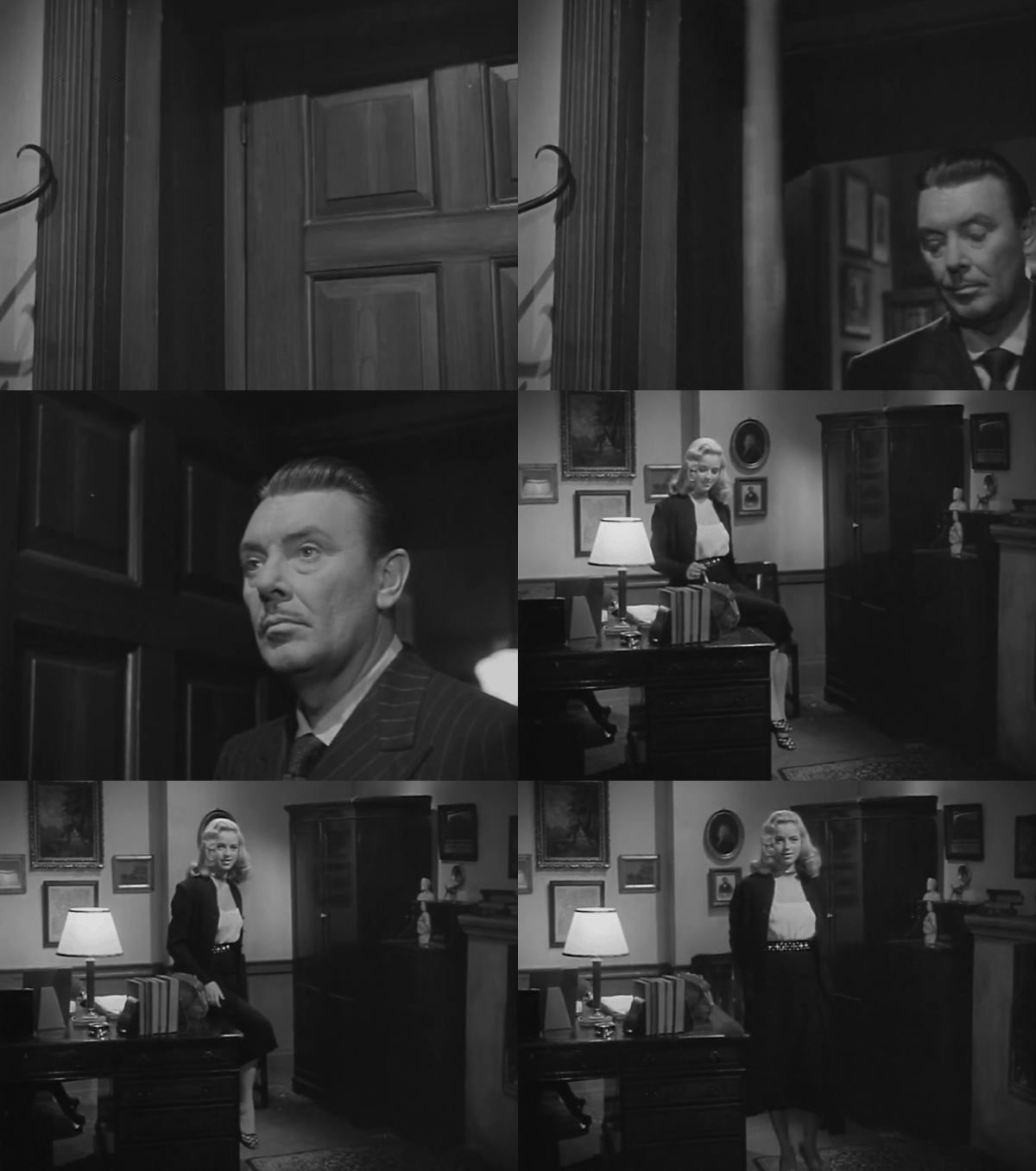
Why is Ruby suddenly interested in Harman? I have no idea, and neither does the movie. There is absolutely no hint of Ruby being attracted to Harman at all before this scene, and it frankly makes no sense in the context of what happens next. Harman, established early in the film as being impulsive after lengthy hospitalization for combat-related PTSD, gets a little overheated when he sees the hot young thing in his office, and responds when she slides in for a kiss. He quickly thinks better of it, she doesn’t seem to mind either way, but gets upset moments later when her nice blouse is ripped on a filing cabinet. Still flustered, he gives her a few pounds for a replacement, everything is fine, they get back to work, and we fade into the next scene with Ruby meeting Jeff after work at the club.
Jeff hears the story and his little weasel brain starts mulling the situation. We’ve since learned that Jeff has just gotten out of jail and he’s dead broke and willing to do pretty much anything to change that. Ruby has no idea, though, so when he asks Ruby about Harman’s finances, she spills that she’d just seen an insurance check on Harman’s desk for over £300. Jeff becomes enraged that young naive Ruby didn’t take the opportunity of a quick kiss and ripped blouse to extort Harman for at least £100 of that insurance check. He punches the hell out of Ruby’s arm where her blouse was ripped, then instructs her to go back to work the next day after the bruise forms, tell Harman he injured her, that blackmail him… and share some of that sweet, sweet extortion money with Jeff, of course.
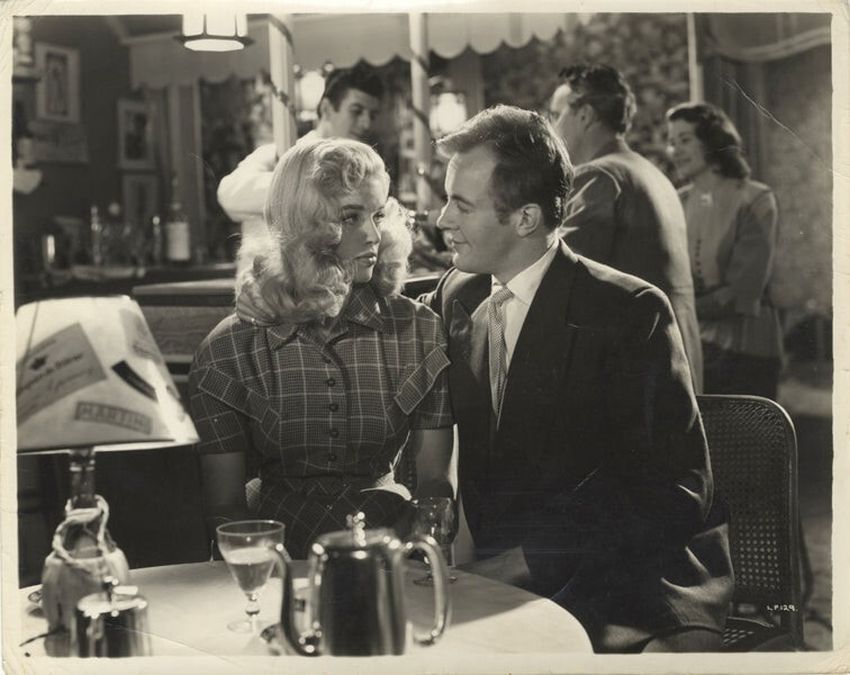
Ruby isn’t the kind of girl who can scare a hardened veteran like Harman easily. This is a man who is married and has already shown interest in his employee Stella Tracy (Marguerite Chapman) for years — before working with him at his bookshop, she was his nurse in the military hospital, and they clearly have some kind of history together — so he’s not going to panic over a single kiss with a young girl. When her first attempt fails, Jeff forces Ruby to threaten to send a letter to Harman’s wife, bedridden with a vaguely defined chronic illness, telling her about the incident. Harman doesn’t fall for that, either, so Jeff, mostly just because he’s an asshole, sends the letter.
The fallout from sending the letter is two deaths, mostly old-fashioned, genteel, British cozy-murder style deaths, but deaths all the same, a short police investigation, and Harman’s realization that he’s about to be framed for a murder he didn’t commit. He goes on the lam and gets help from the ever-faithful Stella to try to uncover what he’s sure is a clue he only half remembers from the night of one of the murders.
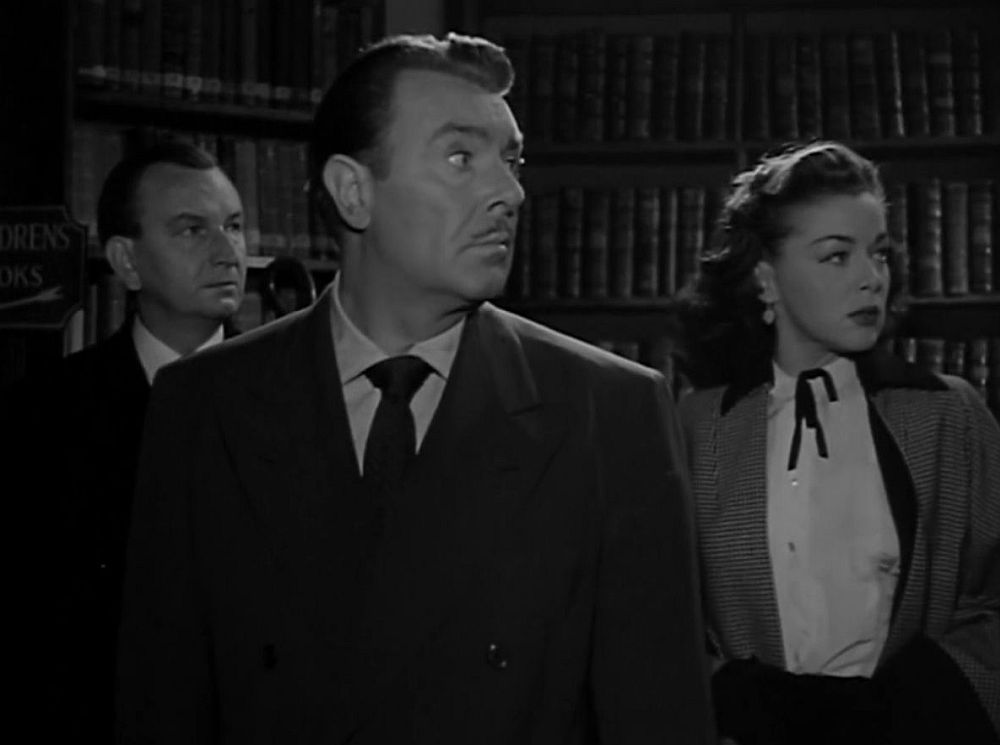
Man Bait is a lesser-known film that really shouldn’t be. It’s director Terence Fisher’s first movie for Hammer Films, marking the beginning of a legendary career he’d have with the studio. It’s one of the first films made at Bray Studios, having just been converted to a movie studio a few months prior, and also the first proper American release for British sexpot Diana Dors, and is one of the better entries in the tight little British thriller market of the 1950s, short and sturdy black-and-white movies made on small budgets, meant to be exported to the U.S.
Fisher was still somewhat new to directing when filming for Man Bait began, and the time and budget constraints seem to have thwarted him somewhat. Those of you who have seen his 1950 film So Long at the Fair will probably be taken aback at the near-constant medium shots with conversations in profile, one person on the left, one on the right, with the person on the left moving five or six steps further to the left after a few sentences to change the background just a little, then doing it again
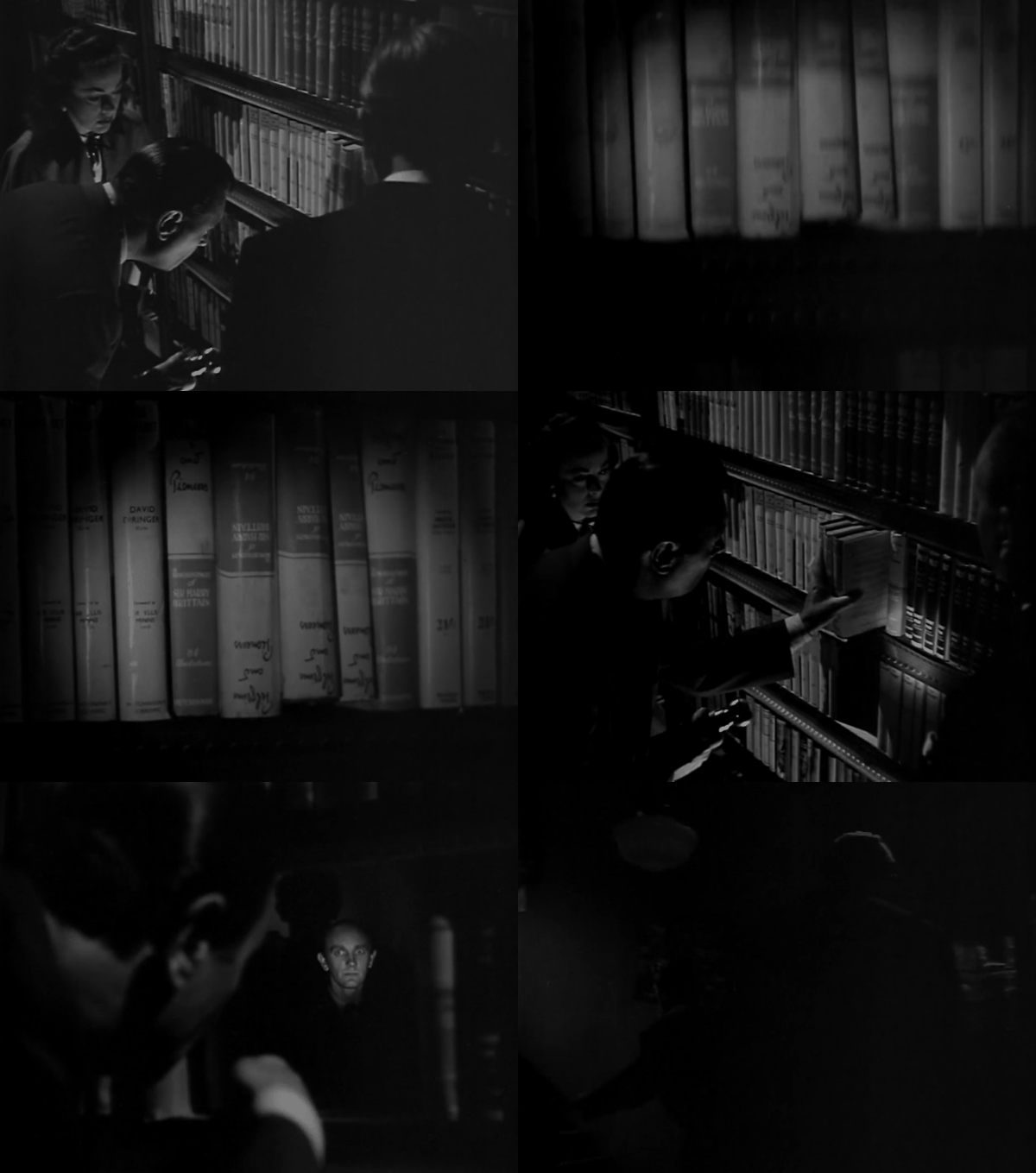
That said, every single location in this film is tremendous, and whoever was responsible for scoping out the filming locations earned every penny of what I assume was a mediocre salary. The backgrounds are interesting and full of texture, sometimes from overstuffed little corner shops, sometimes endless shelves overflowing with books. Apartments have textured glass panes, trompe-l’œil details and just enough ruffles and patterns to keep the eye from getting bored, and the club has some saucy, stylized nudes on the walls.
The sets may be flawless but the cast looks positively impeccable. Every hair is in place, all the clothing is stylish and tailored and steamed into perfect pleats and drapes, with the exception of the crumpled George Brent who never asked himself if his suit was too large, apparently.
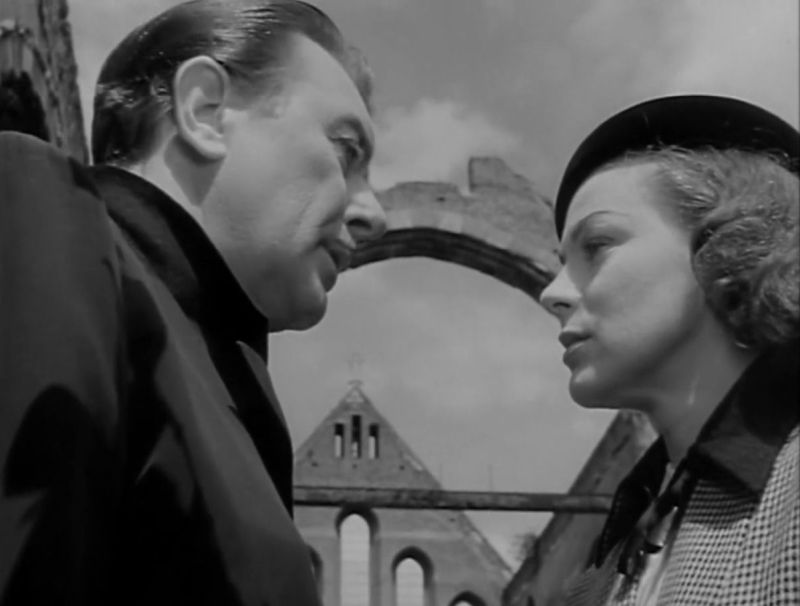
If you’ll allow me the indulgence, a little tangent: When researching filming locations, I discovered that the crumbling church Harman meets Stella at were the bombed-out ruins of St. Saviour’s Church in Ealing, destroyed in 1940 during the Blitz. While looking up photos of St. Saviour’s, I was shocked to discover a distant cousin of mine died when another London church was bombed in 1941. Hazel Kissick, only 18 years old, was on the top of the tower at St. Peter and St. Paul’s Church in Bromley, acting as a volunteer fire watcher for the community, when a German bomb destroyed the church; Hazel was found dead at the top of the tower the next day. Someone took the remains of the bomb that killed her and made it into an umbrella stand, because sometimes people are creepy and weird. Last year, the bomb was given to the now-rebuilt church, who understandably don’t seem to know what exactly to do with it.
In less morbid news, there’s a fine post here at A London Inheritance, which has become a favored blog of mine recently, featuring St. James’s Church in Piccadilly, which you can see behind Clive (Raymond Huntley) and Stella as they have one of those mid-shot conversations that are always happening in Man Bait, but this one is a little more interesting because you can briefly see people leaning out the windows of St. James’s, watching as the scene is filmed.
This is the Hammer-Amicus Blogathon, of course, but I’d be lying if I said I wasn’t just as interested in Man Bait because of Diana Dors as I am because it’s an early Hammer thriller.
Diana Dors was born Diana Fluck, a fact I mention without further comment, and by all accounts seems to have decided she would become a movie star when she was a very young child. I say “by all accounts” but it’s difficult to find much information about her at all; most comes from Diana’s own books and interviews with the tabloids, much of which is fabricated, though there’s more accurate information in the biography Come By Sunday by Damon Wise, film writer and critic.
Come By Sunday paints Diana as the instigator and aggressor even in situations where she was only 12 or 13 years old, making it quite an uncomfortable read. The gist of the situation is this: By 13, she was dancing at GI dance halls; by 14, Diana was dating American adult GIs; and by 15, dating the already-married actor Guy Rolfe, who was 36 at the time. These relationships were allegedly sexless, but I question that, mainly because I’m a woman who has lived a life in the real world and who knows there is no 36-year-old man who is dating a 15-year-old girl for the scintillating conversation.
Diana first appeared on stage at age 14 and in movies at age 15, changing her last name from Fluck to Dors — you all know why — and her career progressed steadily for years, mostly on her looks. Kenneth Tynan, after seeing Dors in the stage play Rendezvous, famously wrote in the Evening Standard: “I cannot guess whether Miss Dors has any real talent, and I do not violently care… Miss Dors is a landmark rather than a performer, and I expect the National Trust already have their eyes on her.”
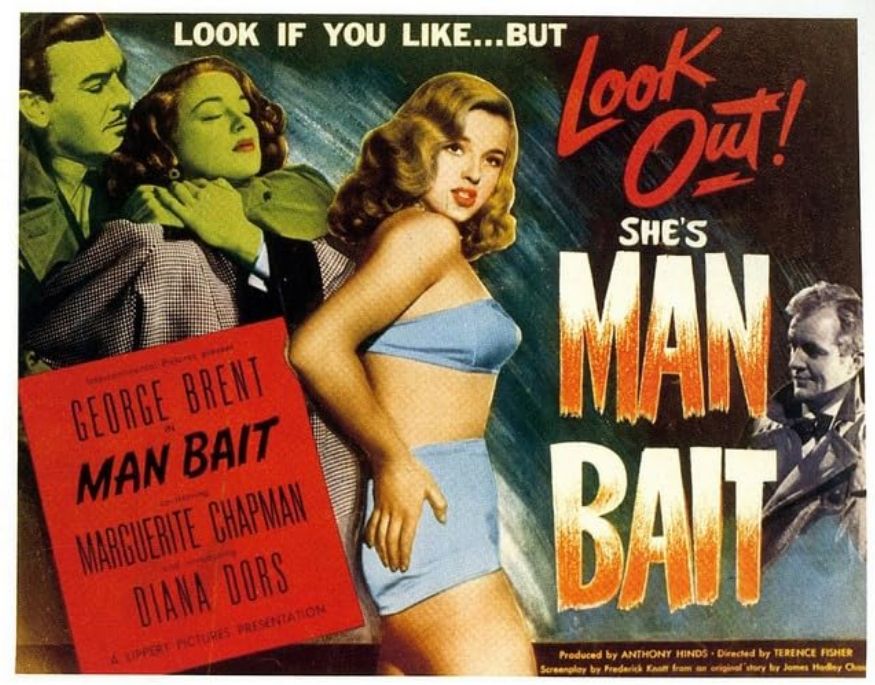
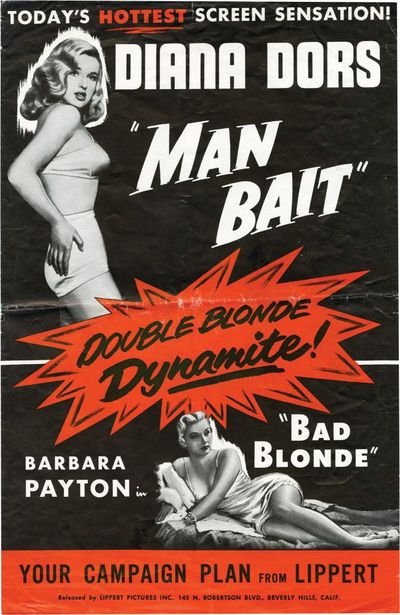
By the time she appeared in The Last Page, she’d attracted the attention of the lucrative American film market, who agreed to distribute The Last Page as Man Bait, and plaster Diana in a bikini all over the publicity. Producer Robert Lippert offered Diana a contract for American films on the condition she divorce her then-husband Dennis Hamilton, so she could be marketed as sexy and single. Hamilton was reportedly abusive, and various sources suggest either she never would have agreed to divorce her husband for her career, or that Hamilton became violent and scared her out of the idea.
Either way, Hamilton, a former professional boxer, had taken over managing Diana’s career, which may explain how she went from the very good Man Bait to the very completely terribly horrible An Alligator Named Daisy, but we’ll get to that in a moment. By 1956, her career trajectory had gone so far off course that her first real American press event, meant to introduce her to the country as a promising new star, ended in chaos when reporter Stuart Sawyer pushed Dors, Hamilton, their agent and her dress designer into the swimming pool, and got decked by Hamilton in response.
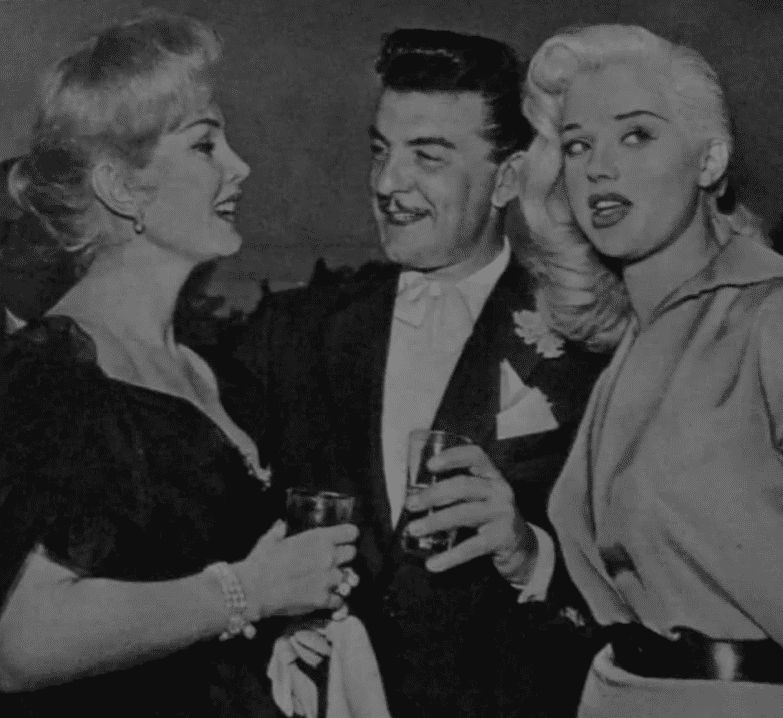 Diana with her husband Dennis Hamilton and Zsa Zsa Gabor at the August, 1956 press event held at Diana’s Beverly Hills home, before everyone ended up “accidentally” in the pool and a fistfight broke out. You can find this and a small album of photos from that day here.
The gorgeous Beverly Hills home and the pool where all this happened are still there, and in looking at the photos online, one wonders how on earth she could have afforded that at the time. My guess, based on all evidence, is that she couldn’t. She was perpetually broke and constantly blaming others for her financial predicaments; sometimes that was true, sometimes not.
Years ago I featured a short Diana Dors theme week here on SBBN, having just seen her in a double feature on TCM of As Long as They’re Happy and An Alligator Named Daisy. Diana interested me but the movies absolutely did not; they’re both terrible. Later, I watched Dors in The Unholy Wife and Man Bait, felt there was some real talent in Dors there that popular culture hadn’t fully tapped into, read on Usenet[1] that she was very good in the cult movie Deep End, so I watched that, too.
Now, I don’t regret watching many movies, but folks, I regret watching nearly every second of Deep End. There’s a common bit of lore out there that David Lynch loved Deep End, but the only thing he said about it was that it had “really great art direction” especially for a color film, and it does! The aging bath house is especially compelling and I still think about it more often than one would normally think about such things. But I also think a lot about the flippant attitude the film takes toward sexual assault, and how a puffy, aging Diana Dors cheerfully puts in a clumsy, boring performance that’s meant to be shocking in a darkly comedic way, but is just a reminder that, by 1971, she’d lost any talent she may once have had, and that was being exploited in a ham-handed attempt to achieve the grotesque.
There aren’t many movies that I hate so much that I start to hate everyone associated with them, but An Alligator Named Daisy is one of them, and Deep End is another. Between that and my notable lack of writing experience, I really didn’t give Diana as much of a chance as I should have back in the early days of this blog. I also found myself thinking about Man Bait frequently, especially after watching Cash on Demand last month, plus I felt vaguely guilty because the tasteful near-nude of her I posted is one of the blog’s most popular posts, which is what happens when you post boobs on the internet.
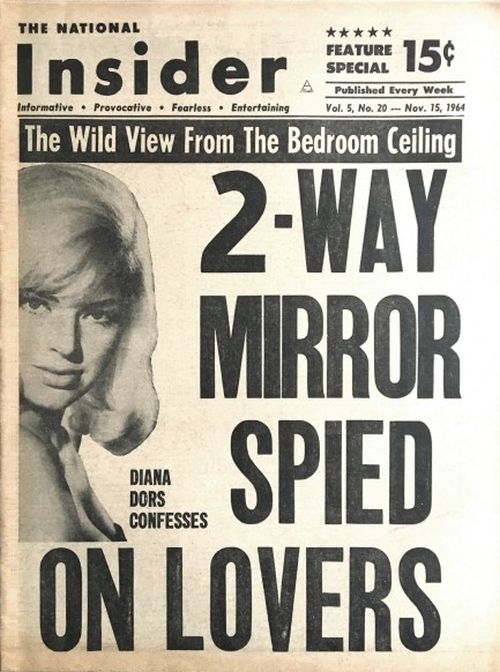 But I also in the intervening years had forgotten that Diana Dors is — with apologies to her fans — a real pain in the ass. Don’t get me wrong: I am, too, and in some ways this is a game recognize game situation, but I’d be lying if I said she was the normal kind of crazy we expect in a celebrity. She was a full-blown, four-color mess, and wanted attention so badly she’d happily talk to the tabloids about anything, even to admit to filming couples having sex at her orgies without their knowledge.
We’re deep into tangent territory already, so you’ll forgive me for putting a tangent inside a tangent, but something that strikes me about all these articles on Diana’s sex parties is that none of them mention Richard Dawson, who she was married to for several years just after some of her raciest scandals. Did she go cold turkey on the sex parties while married to Dawson? It’s interesting to speculate in a was-there-a-confidentiality-agreement-in-the-divorce-paperwork kind of way, even more so when you realize just how much Diana Dors talked. There was nothing off limits, it seems, except apparently Richard Dawson.
It’s likely that a lot of the gossip she dished out were lies, according to Come By Sunday, so maybe she felt it was safer to tell her stories about her dead first husband who could not legally be libeled than it was about her second husband who was enjoying a decent career in the States. The lies, however, are part of why I called Diana Dors a pain in the ass earlier. It’s not really about authenticity, because I don’t think an artist has to be experiencing real emotions every moment of their performance to be authentic. In The Other Side of the Rainbow, Mel Torme whined about Judy Garland “faking” tears on stage during the finale of the “Born in a Trunk” number, complaining that he thought it was authentic the first time he saw it, but the second night she cried at the same point in the song, and he realized it was just performing.
As far as I’m concerned, that’s just Mel Torme telling us he doesn’t know what the fuck performance even is. Torme didn’t have a lot to offer emotionally or in his personal life, and Diana Dors is the same way, to an extent. She’s fine as an actress, enjoyable to watch, competent, understands the job and does it well, but there’s no emotion there, and the more I read about her and her personal life, the more I think there wasn’t a lot of personality there to be revealed in the first place, which sounds like an insult but I genuinely mean it as an explanation. Some people aren’t that deep, and that’s okay.
Dors gives a solid and competent performance in Man Bait, her voice is just terrific, she holds herself well, understands the camera and how to move for it, has presence and confidence, and is of course very pretty. Well, very sexy more than very pretty, but that’s the movie biz, baby. There’s some talent there and Man Bait makes me wish she had stuck with acting instead of getting attention at any cost.
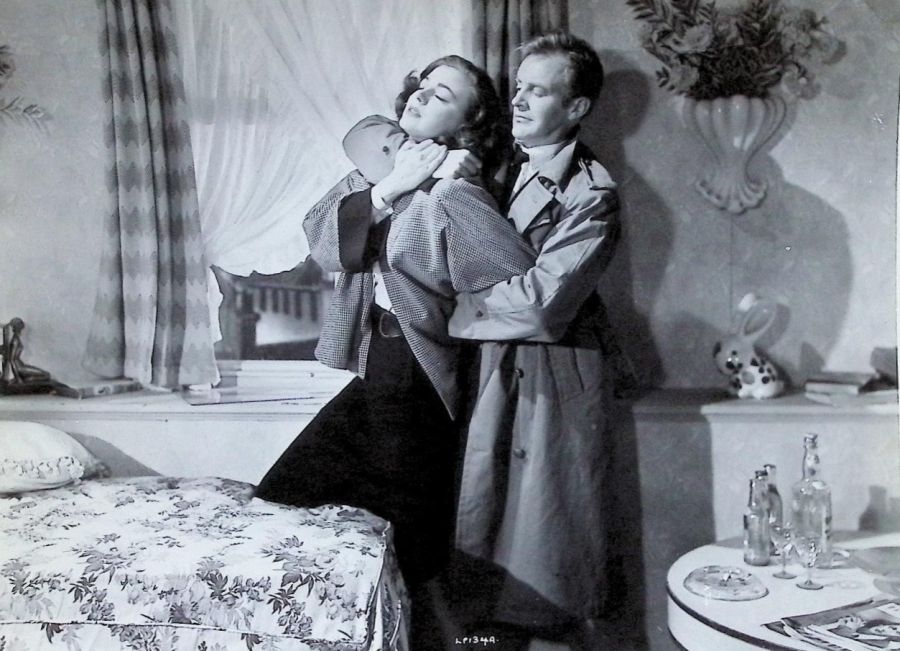
Compare and contrast this promotional photo with the poster at the top of this article and prepare to be shocked to discover that the poster is lying to you! It’s typical for a B movie to make their product look scandalous to try to get butts into seats, but this is a particularly egregious example.
I wish Man Bait had been treated more seriously at the time it was released, and I wish it was better known, and I wish it was easier for people to watch it. The movie is more than a historical curiosity or an early entry in a legendary director’s career, it’s a fine example of the simple, entertaining, fun little thrillers that movie houses used to show to everyday audiences. You couldn’t really ask for a better way to spend a lazy Sunday afternoon than seeing Man Bait in a matinee on a double bill with Bad Blonde (1953), another Hammer export to the States. Hammer released these as as double-feature DVD several years ago, so if you find yourself in a thrift shop and stumble across this in their DVD bin, check it out, you will not regret it.
[1] Not 48 hours ago a friend of mine responded, “Gawd Usenet!” at my mention of Usenet in an unrelated conversation, but it’s an evergreen sentiment. Gawd Usenet, indeed.[2]
[2] You’re not supposed to have just one footnote without a second one, so here’s the second one. Take that, Chicago Manual of Style!
OTHER SOURCES:
1) Scan of the New Musical Express interview with David Lynch from 1980 where he briefly mentions Deep End.
2) Connecting Dors
3) Hurricane in Mink
4) Diana Dors sex parties article (one of many)
5) Apocalypse Later’s fantastic article on co-star Marguerite Chapman