
Tag Archives: camp and cult blogathon

That Was The ‘Thon That Was

Thank you everyone for a delightful Camp & Cult Blogathon! There were 29 entries, which is amazing; even more amazing is that every single post is terrific. I don’t just say that as vague praise, I genuinely mean it. The page will remain up indefinitely, so if anyone ever needs some inspiration, dive on into those links. You won’t regret it.

No good ‘thon goes unpunished, as I learned during the Shatnerthon a couple of years ago, and the same held true for the C&CB. There were a few technical glitches, the usual hacking attempts that apparently every WordPress blog endures, and one self-inflicted issue where I added new links to the main page and then promptly forgot to save the changes. I won’t take full responsibility, though, partly because I’ve got kind of a thing with responsibility (it sucks, as any adult will tell you) but also because my brain was fried after 12 posts in 12 days, even if one of those posts was just a photo gallery. My AC joints, my carpal tunnel and my neurons are all still bruised, but it’s a good bruise.

Today is October 1st, which means most of you are embarking on a month-long horror gorge, and you all have my most sincere blessings in your endeavors. Now that the chaos of the last month is over, I hope to catch up on your blogs and regular SBBN posts and things. A State of the Blog will be coming in the next few days as well.

On that note, I want to mention the Val Lewton Blogathon, held by Kristina at Speakeasy and Stephen at Classic Movie Man. Entries are due by October 26, and they will all be listed on Speakeasy and Classic Movie Man on Halloween, making that day even better than it already is. Check it out and sign up!

Thank you again for stopping by, and I hope you all have a wonderful October, which is the Latin word for “BEST MONTH EVER.”

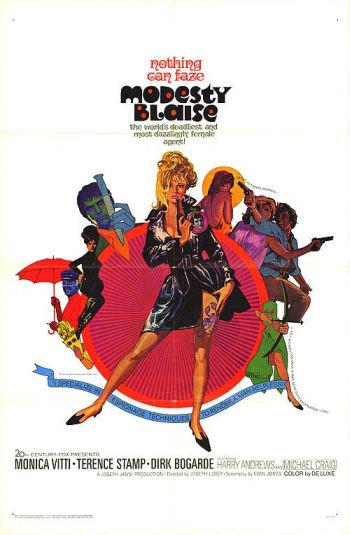
Camp & Cult Blogathon: Modesty Blaise (1966)

Welcome to Day Twelve, the final day of the Camp & Cult Blogathon! Don’t forget to read the submissions here on the main page. If you have one to submit today, please email me or comment here, and it will go up later tonight.

Thanks go out to so many of you for the terrific submissions, great comments, retweets, participation, and general revelry during this really, really long blogathon. It has been an amazing time, and I hope you’ve had as much fun as I have.

***

For my final entry, I hope you will forgive me for submitting a short post. My acromioclavicular joints are madly protesting these twelve long days of typing and won’t allow me to do much today.

But that is probably for the best, since I have very little to say about Modesty Blaise (1966) that has not been said before. A terrific run-down of the film can be found at Cult Movie Reviews here, and it is highly recommended reading.

Monica Vitti is Modesty Blaise, fabulous international spy-slash-jewel thief. She is hired by Sir Gerald Terrant (Harry Andrews) of the British government — I think, but I’m not sure, for reasons I’ll explain momentarily — to make sure £50 million in diamonds gets to the proper Middle Eastern sheik in exchange for oil reserves. Modesty warns them that if she is not told the full story about the diamonds and the plans to rob them en route, she will consider herself a free agent and steal the diamonds for herself. Thus begins a strange series of events that are part spy spoof, part random stream of consciousness events, and partly based on the long-running comic strip begun in 1963.

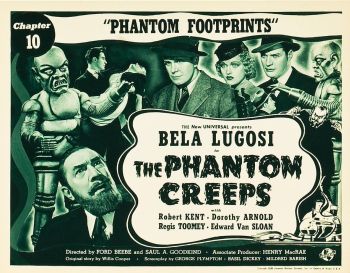
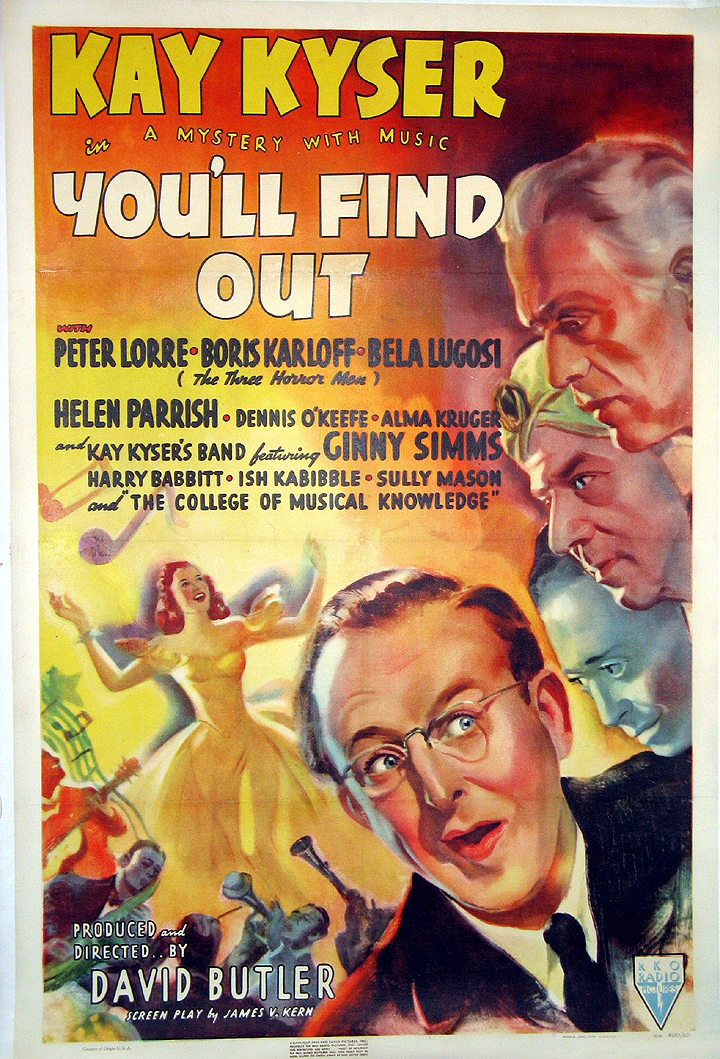
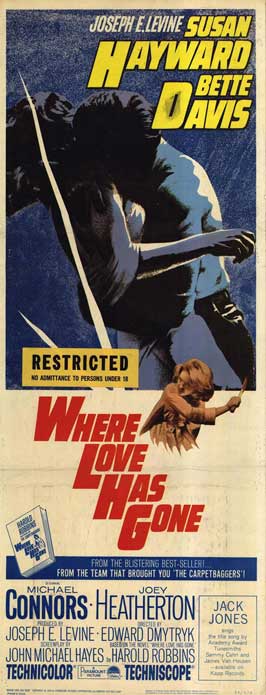
Something that this ‘thon has solidified for me is that a film can be as crazy, stupid, strange, inept or dull as possible, but as long as there is a cohesive internal theme running throughout, I will forgive a lot. A lot. For instance, Sh! The Octopus is one strange damn movie, irritating on all fronts, but the finale explains the entire film and thus redeems it for me. You’ll Find Out sticks to its really silly guns for the entire film; Where Love Has Gone insists upon being trashy for every second of its run time. Meanwhile, Lace only dreams of being as trashy as WLHG, Island of Doomed Men simply can’t keep its focus for even a short run time, and Modesty Blaise, similarly, jumps all over the place like a bad Vaudeville act. You don’t like that joke? I got another, and another, and another, and eventually you will laugh.

Truth be told, you probably won’t. The plot is obviously secondary, which is why it’s impossible to know why the British government hired Blaise in the first place. They keep important information from her and try to send her on pointless errands in the same way they try to fool the actual thief, Gabriel (a tremendous Dirk Bogarde). Maybe they want to keep an eye on her in case she steals the diamonds, or maybe they were hoping to fool her into helping, or perhaps knew she could get the diamonds to the Middle Eastern powers they want to have them because she knows Arabian royalty.

It’s all unclear, which would be fine if the action or if the satire was worth watching on its own. There are times when Modesty Blaise is truly playful and fun, mostly when Dirk Bogarde and Rossella Falk are on screen, but so often it’s just inexplicable. For instance, the humor intended in the scene where Modesty sneaks into her sometimes-boyfriend’s apartment is completely unfocused. It’s impossible to tell if she’s there to spy on him because she believes he’s working for the government that is trying to trick her — and of course we have no idea why they would be anyway — or if she thinks he’s after the diamonds too, or what. There’s a moment where he thinks she’s an ex-girlfriend of another name, and it’s possible Modesty was once in disguise as that other woman, but what does it mean? Was he previously in a relationship with both Modesty and her alter ego? Or did he just find out he was dating Modesty the whole time and never knew?

Scilla Gabel, Lex Schoorel,  Rossella Falk, Joseph Losey, Monica Vitti, Dirk Bogarde, Tina Aumont


The biggest question, though, is why the viewer should care. There has to be a reason to care about Modesty and her antics, but when a character has no actual character to relate to, it kills audience interest. Modesty in the film is whatever the filmmakers wanted her to be at that moment. If bumbling seemed funny, then they made her bumbling. If hyper-intelligent was funnier, then that’s what she was. That said, I wondered often if Vitti’s obvious disinterest (or inability) to pull off the more gymnastic action scenes was responsible for her seeming to be so bumbling.

Joseph Losey, responsible for films such as Boom! and Secret Ceremony (1968), These Are the Damned (1963), and The Boy With the Green Hair (1948) knows how to craft a film. But imagine a film made up entirely of the slower, unfocused parts of Boom! and Secret Ceremony, with added forced wackiness and a hint of stunt casting, and you’ll have Modesty Blaise.

***

That’s it for the official SBBN contributions to the ‘thon! I’ll be back with a final wrap-up post on Saturday. Meanwhile, it’s not too late to get your own submissions in! Any posts I receive today will go up later this afternoon and evening.

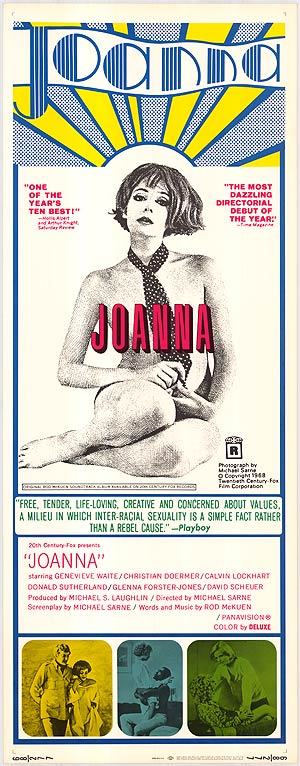
Camp & Cult Blogathon: Joanna (1968)

Welcome to Day Eleven of the Camp & Cult Blogathon! Tomorrow is the last day, so if you have any submissions, make sure to get them in soon. I do accept late submissions, though not too late. Don’t show up in 2013 hoping to be added to the list, is all I’m saying. The master list of submissions is here, with new posts added every day.


***


Joanna is a film I first saw on Encore nearly 20 years ago, back when the channel was my go-to place for old films. Truly, while TCM has been my self-inflicted Master’s degree in filmology and filmonomy, Encore was my undergraduate degree, and of the amazing 1960s and 1970s films I saw, Joanna was probably the most influential. But it had been twenty years and I quite honestly didn’t realize how much of this film I carried with me, how many moments in this film informed my own viewing, completely unconsciously of course, never quite remembering when or how I first saw a certain tracking shot or specific editing technique.

Because it was so hard to find, I didn’t know how influential Joanna was for me until I saw it again tonight, a full two decades after it last showed on Encore. Now, I watched it whenever it was on for those few months, as Encore had a habit of repeating shows several times. That explains why, to this day, the theme song from the finale of Joanna will get stuck in my head, often at random times but most especially if I hear the word “Cinemascope.”


The opening of the film is black and white, turning to color when Joanna arrives on a train. The same technique would be used in Sarne’s Myra Breckinridge on the DVD restoration, which was discussed extensively by Marc at The Projector Has Been Drinking in a wonderful post for the Camp & Cult ‘Thon.


As you can see from the title screen, the aspect ratio is not quite accurate. Some of the left side is missing, which shows in the long-focus shots with action on the far left edge and in the credits. After years of not being able to find this anywhere, I got the recent “Flipside” version from the UK, which comes with both DVD and Blu-Ray. This article states it is the theatrical release aspect ratio, but I’m not convinced; it does accurately note the density fluctuation, which is prominent in many scenes. Areas that look like they were damaged during a pan-and-scan transfer still remain, too. This print, however, is the best you’re going to get, and it comes with two of Sarne’s early shorts including Road to Saint-Tropez with Udo Keir. I mean, c’mon man. UDO. Also the extremely rare Death May Be Your Santa Claus. The full release is discussed here at BritMovie. Why don’t you own this already?

The IMDb — and lord knows where they got this, but it’s the plot most people are going to see when they look this film up — is “A provincial girl is entangled in the mod morality of London,” but that’s not really what it’s about. Joanna is about modern life in its way, of course, the modern life in the world of 1968, but Sarne has the wonderful ability to focus on the bits of life that transcend eras, that are common at any time in the history of humanity, and if you’re willing to look past the fashions and the makeup these themes become unmistakeable.

Joanna was quite influential in cinematic circles. In it you can see the seeds of Pennies From Heaven, both the original UK miniseries and the later Steve Martin version. My beloved Cleavon Little unquestionably channels Calvin Lockhart’s character Gordon for Sheriff Bart, and the film anticipates by several years the trend toward 1920s and 1930s nostalgia that hit its peak in the 1970s. Michael Sarne’s direct referencing of classic Hollywood film stars mirrors the homage and imitation from La Nouvelle Vague, but with a more vicious edge, basically praising the image of old Hollywood by deconstructing it to the point of destruction and re-forming it into a 1968 context. It rids these images of much of their sentimentality, and truly, I don’t think one could ethically indulge in a sentimentality of 1930s Hollywood while also exploring the issue of race in the 1968 Western culture; at the very least, waxing nostalgic over unmodified 1930s films and all that they represent — including base, undiluted racism — would undermine the relationship between Joanna and Gordon in this film.

Both Fellini and the New Wave were obviously influential on Sarne, especially in his dedication to a non-linear narrative. The conceit of showing a flashback to something a few moments before, sometimes maybe only 15 seconds prior, is interesting and it grounds Joanna’s intent, but by explaining Joanna’s thoughts so literally there is a loss of ambiguity. That narrows the perspective of the film and cuts off viewer interpretation in a way that I’m not entirely sold on, however.

Michael Sarne is clearly quite knowledgeable about cinema but also loves them, which isn’t always true of those who know a lot of about film. His love of films is also a love of filmmaking, which is quite evident throughout. There is a terrific sequence early on where Joanna is seen in a dark sage green jacket and white jumpsuit, walking away from her art class and telling her friend she doesn’t know where she’s going.

As she skips off, her clothes begin to match her surroundings completely, the green of the plants the same green as her jacket, the white of the walls the white of her shorts. She wanders into a friend’s studio, with the railings the same green and the walls the same white. Joanna meets new people, all having details of their wardrobes the very same shade of green. It’s absolutely delightful, drawing all characters together while visually acknowledging the shallow, surface relationships these people are forming during these scenes.

One can’t discount that the color coordination of outfits is not some sly metaphor for the color-coded society Sarne explores in Joanna. The title character (played by Geneviève Waïte) is an 18-year-old in London to attend art school. She’s not particularly appealing, being selfish and rude and naive and greedy, but she gets away with it like pretty much every ultra mod beauty in the Swinging Sixties did — by being adorable and willing to hop into bed with anyone.

The fourth wall is broken frequently, and the iconic images of classic Hollywood films are literally papered over much of the background.


Joanna meets up with Beryl (Glenna Forster Jones) and her brother Gordon (uber-dreamy Calvin Lockhart), who both know Lord Peter Sanderson (an amazing Donald Sutherland). Sanderson takes his girlfriend Beryl, Joanna and her boyfriend Dom on a trip to the tropics, spending his copious funds to treat others to a fun time and have as much fun as he can before his unspecified illness eventually kills him.

Throughout the film, Joanna finds herself in a series of inappropriate relationships, being hit and insulted and destroying marriages almost daily. She finally finds her true love in Gordon, and after a series of events straight out of a gangster-themed pre-code, she loses Gordon and is forced to grow up. There are larger themes of social hypocrisy, as well as exploration of Joanna’s deep neuroses.

What I’ve noticed in a lot of reviews is that her dream/daydream sequences are taken as literal, or as just random shots inserted by a confused Sarne, though they are obviously comedically Freudian dreams and I fail to see how that isn’t easily recognizable. When she’s threatened by Beryl she daydreams about having the black woman as her servant; when she’s rebelling against Daddy she dreams of finding him mostly dead but still with enough strength to beat her. When real life with Gordon starts to mirror her fantasy daydreams of a better, more glamorous past, she finally finds the world she wants to live in.

That’s not to say there are no faults to this film, because there is a lack of focus and a desire to be as candy-coated and ultra mod as possible. Take this series of shots, beginning with Sanderson, Beryl, Joanna and Dom having lunch, then a transition shot of the nearby sea, then the three friends later that day discussing whether Sanderson is ill or not:


Beautiful, saturated colors, lovely composition, probably some of the nicest cinematic shots of a glistening sea I’ve ever seen. Yet the acting in these scenes in some of the weakest in the film, almost as though a script malfunction required an impromptu ad lib from actors completely unable to meet the challenge.

Even the most ardent Michael Sarne fan — and I include myself, given my undying love for Myra Breckinridge — must admit that there is precious little context for the social commentary he strives for, and that the story of a flighty art student’s sexual escapades needs more than earnestness to become a full-fledged film. Still, for anyone who can get past Joanna‘s questionable reputation and not be distracted by Waite’s generous selection of wiglets, it’s more than worthwhile.

Camp & Cult Blogathon: Lace (1984)

Welcome to Day Ten of the Camp & Cult Blogathon! Don’t forget to check out all the entries here on the main page! The ‘thon ends on Friday the 28th, so there are only a few days left, so if you want to submit something, please comment here. If you have trouble commenting on the blog, drop me an email at glitterninja at gmail.com or she at shebloggedbynight.com.

***

When the results of the Reader’s Choice poll arrived, there was a tie between Where Love Has Gone, reviewed here, and Lace, the 1984 miniseries I had planned on watching whether it won the vote or not. Yet, as is often the case, I underestimated the gulf between what normal, sane people consider high camp and what I, a person who is neither normal or sane, considers high camp. I’ve seen hundreds of bad films, and after a while one becomes desensitized to the problems common in bad films. Dull cinematography, poor dialogue, and bad acting are the norm. There has to be more there there for me to really get into it.

That’s not to say Lace doesn’t try its damndest to be trashy and useless, because it does. It is a ridiculous soap opera plot, but the purpose of stupid soap opera plots is to allow room for the other entertaining bits that people watch trash TV for: Sex, scandal, fashion, scenery, and melodrama.

The problem, and I say that as though there is only one problem with Lace which is clearly not the case, is that Lace fails to deliver on the trashy entertainment a miniseries like this promises. Look, I’m aware Middle America loves its G-rated porn, the Hot August Night album cover and the train tunnel ending of North by Northwest and pretty much every frame of Star Trek.

Lace strove to be more than that, or at least pretended to, with its promise to push the boundaries of 1984 nighttime television. But either that was a marketing gimmick or the filmmakers simply were not up to the goal they set for themselves. There is no sexiness or style or entertaining melodrama to be had in Lace, which contented itself to simply be homophobic, sexist, classist, and racist in an attempt to pander to its audience. Well, sometimes it did delve into incest, which I guess is a little naughty… but I get ahead of myself.

Lace is four long hours about three girls who, while in an expensive European boarding school, got pregnant and gave away the baby. We don’t know which of the three girls had the child, as they decide for reasons that are entirely unclear to each claim to be pregnant, even to the doctor. The few adults aware of this situation, primarily the doctor and one girl’s rich and dotty aunt, all play along with this, for reasons that are even less clear. The girls vow to each other that the first one to get on her feet after graduation will take the baby to raise.

The three girls are Judy (Bess Armstrong) from Kansas, British “Pagan” (Brooke Adams) and Maxine (Arielle Dombasle) from France. Much of the show is done in flashback to 1960, when one girl got pregnant, though very little is done to make it look like 1960.

I don’t know about you, but this looks like 1984-era Madonna to me, not 1960.


Judy, Pagan and Maxine all lose their virginity during the same few days — Pagan after almost being raped, because running back to their date late at night and asking to be deflowered is totally what women do after narrowly escaping a sexual assault — and one gets pregnant. We’re not shown which one is pregnant, of course, and the entire four hours is filled with clues as to who is the mother.

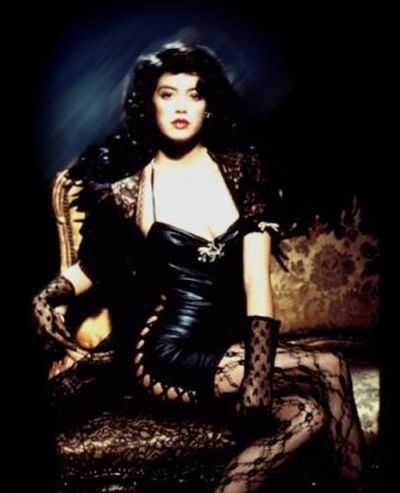
Lili (Phoebe Cates) is a young 20-something actress and modern day international superstar (modern day being 1984, of course) who is on an evil, evil quest to find her mother. She’s bitter and bitchy and rotten in every way, having been abandoned by her bio parents and losing her foster parents when she was very young. She scrambled to stardom by doing pornos, posing nude, and being as scandalous as possible. Now she has embarked on a search to see which of these three women, all now rich and successful, is her bio mom.

Lili insinuates herself into their lives, first by giving a scandalous interview to Judy for her major fashion magazine, but then reneging on her statements and threatening to sue. She then gets involved with Prince Abdullah, ruler of an unspecified (I think) Middle Eastern country and the one Pagan lost her virginity with back in 1960; Lili seducing Abdullah means she could be sleeping with her father. At the same time, she crashes Maxine’s family and sleeps with Maxine’s 17-year-old son who could be her brother.

The catfight between Lili and Maxine is taken so literally that Cates actually tries to make little meow-meow cat claws, grr! with her hands.


After upsetting everyone, Lili invites them to her apartment, promising to resolve the problems each of the three women have with her. This of course leads to the infamous phrase, after she’s gathered them in her home, “Which one of you bitches is my mother?”

But one hilarious phrase does not make an entire four hours of miniseries worthwhile.

The biggest kink in Lili’s plan is that all three women plus Maxine’s dotty aunt, who was involved in the scheme, believed the baby died in about 1966 in an accident. We learn through flashbacks that her foster parents were actually killed by Communists while trying to sneak someone out of Bulgaria I think (honey, I am so not going back to look it up) and Lili was sent to a Soviet detention camp after their deaths.

A bit should be said about the performances. Bess Armstrong is not the most versatile actress in the world, but she has a terrific strength of presence on screen, and because of this she stands out from the rest of the cast. Brooke Adams is supposed to be British, yet her accent didn’t kick in until about 18 minutes into the film, and most of the time she doesn’t bother with it. Well, no one has a good accent in this film. Unless they are allowed to speak with their original, natural accent, no one in Lace can pull an accent off. But besides that, Adams is dull, dull, dull. So dull. Also dull is Arielle Dombasle, who quite simply cannot act.

Speaking of, Phoebe Cates’ acting is unbelievably bad. Her accent is some vague European thing that comes and goes, and she sways and totters and head-shakes so much that I suspect she drank heavily during the filming, which kind of makes me feel bad because I, too, would drink heavily during the making of Lace. But Cates’ acting is as uniformly terrible as Adams’ and Dombasle’s, and after about an hour of it there’s nothing to do but yawn. Oh, is Cates moving her arm stiffly like she’s pretending to be a Barbie Doll again? Oh, has Brooke Adams forgotten to blink during her close-up again? Whatever, I’m going to go sort socks and get some excitement in my life.

That said, it is rather funny that, after Lili meets Aunt Hortense, the dotty old aunt dies, because it seems for a moment that Cates’ acting was so bad it killed Angela Lansbury and she ought to feel pretty bad about that.

The cinematography is beyond dull. Quite a chunk of cash must have been spent on location shots, which are used mostly as background as someone drives off. At times you’ll get an establishing shot, like this one of Pagan walking back to a cafe table:

But then the rest of the scene will play out with the same mid-distance framing used throughout the series. And every character is framed this way when they’re not in a full close-up (like Anthony Higgins below), and it’s boring.

I may not remember much of or even understand the 1970s, but I both remember and understand the 1980s, much to my psychological detriment. In my house, the television was on constantly. My parents could not stand one moment without the television on, and would often come upstairs to my room and literally prevent me from doing homework to force me downstairs to watch whatever dreck they had on. My tastes ran to “Magnum, PI” or “Airwolf” or “Mike Hammer,” which weren’t perfect but were much less problematic than the shows my parents enjoyed. Let’s just say they ranted for years that “Mr. Dugan” was stopped by those horrible hippie liberals who obviously hated white people having fun.

So I know far too well how bigoted the general television landscape was circa 1984. Not just American shows but British ones as well; there are a few “Inspector Morse” and “Sherlock Holmes” episodes that do not wear well. However, the sheer amount of bigotry in Lace was astounding to me, especially the pointless homophobia.

For instance, in the 1960 segments, the headmaster (Herbert Lom) is rumored to be gay and having an affair with his chauffeur. The chauffeur is bi, which means he’s also a rapist and pervert. It’s an undeniable cause-and-effect situation. The girls steal intimate photos of the chauffeur and the headmaster, making sure they all go “Oh gross” a bunch of times to emphasize how icky gay sex is, then use the photos to blackmail the headmaster into not expelling them. Honor Blackman shows up in a thankless role of a woman who is evil precisely because she is lesbian. That means she’s also a pedophile and a white collar criminal; Lom’s character was also a pedophile. Note that the 20- and 30-something men the girls sleep with when they’re 16 aren’t considered pedophiles at all. Not even the sleazy porn producer that Lili hooks up with as a young teen is portrayed as a pedophile, only the gay characters.

There is also a student they hate who is fat, customers and other tourists who they mock for being fat, and repeated mentions of hoping their little girl won’t grow up to be fat. Nearly everyone in this film is white save for one singer seen for maybe five seconds in the background and a small part played by a Middle Eastern child. Most Middle Eastern characters are played by white people in makeup, sometimes with gloves on so the makeup department didn’t have to deal with their hands. There is one black soldier seen when Judy is a reporter during the Vietnam war. The soldier doesn’t think a civilian should be on the front lines, and though in his two lines he never says a thing about her being female, she “zings” him by calling him a bigot. Later some white guys joke about raping her and tell her to go home and make babies, and she doesn’t zing them at all.

The sexism… don’t even talk to me about the sexism. If Lace was about anything, it was about the furthering of sexism in American culture in a manner that would make ABC as much money as possible.

This is Lili in a porno. Yeah, that’s super convincing.

These are two crew members on the porno in a scene that is stolen straight from Citizen Kane. I laughed really hard at this, but I suspect one was not supposed to laugh.


As you can see from the IMDb reviews, many people like this miniseries. “The acting was superb” and “fantastic,” the show was a “masterpiece” with “fabulous female characters.” The unabashed, unironic love for this series baffles me. When DVD talk calls it “exotic” I can’t for the life of me figure out what they mean. The postcard shots of cars driving past mountains? White people in brownface? The occasional camel?

Anthony Higgins looking dignified in 10 tonnes of makeup.

Many refer to Lace as daring or scandalous, but it really wasn’t, not even in 1984. The hype said it was, so it’s a testament to ABC advertising that even today people think the show was scandalous. But truly, every show I watched in the 1970s was more “daring” than this G-rated tripe, and I include “Electra Woman and Dyna Girl” in my assessment. Shows like “Hill Street Blues,” “St. Elsewhere,” “Trapper John,” and of course “Dynasty” and “Knots Landing” were hits on television in 1984, all more hard-hitting, daring, and scandalous (and often trashier) than Lace ever was. Don’t be fooled by those who claim saying “bitch” on television at the time upset an entire nation; Elton John’s “The Bitch is Back” was a Top Ten hit a full decade prior.

There’s a hilarious “sex” scene in Lace where the film just straight-up compares itself to the sheik films of Valentino, with Higgins bragging that silent films were “heavily censored,” while what he is about to do to Pagan will not be. And then… tepid kissing. The camera shoots them from that same mid-distance it loves so much, pans around so setpieces cover the kissing just in case good ol’ Aunt Edna from Poughkeepsie is getting too riled up by all the tepidness, and not even a shoulder is bared before fadeout.

If you have had any experience with trash cinema, cult films, 1980s television or life in general, the novelty of Lace will wear off right about the hour and a half mark and mostly bore the hell out of you for the rest of the series.

Want to learn more about Lace? Start here. And you want to go there because the blogger’s background is Bert Convy. I’m a big Bert Convy fan.

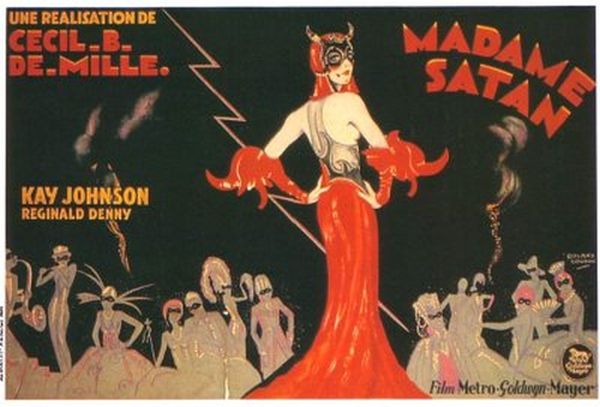
Camp & Cult Blogathon: Madam Satan (1930)

Welcome to Day Nine of the Camp & Cult Blogathon! Because of a lengthy power outage last night, yesterday’s submissions will be up later today. I apologize for the delay, but I need sleep like you wouldn’t believe. Please, check out all the posts that have been submitted so far! These posts are, without exception, terrific. I wouldn’t be doing this without all you bloggers and readers, so thanks go out to you all.

***

When I held a Reader’s Choice vote to decide some of the movies I should do for the ‘thon, I described Where Love Has Gone as “complete insanity.” In retrospect, I should have saved that appellation for Madam Satan, which is some of the craziest damn pre-code fuckery you can imagine. Nothing about it makes sense, although maybe there is some complicated equation that would explain it, something like pre-code plus popularity of musicals in the early talkie era multiplied by Cecil B. DeMille’s untreated mental condition divided by the invention of sequins equals Madam Satan.

Angela Brooks (Kay Johnson) is upset because her husband Bob (a particularly knobbish Reginald Denny) is obviously seeing another woman. He comes home drunk after a night out with his friend Jimmy (Roland Young) and sneaks into the upstairs bed and bath, where he and Jimmy very naturally start showering together. The film is your standard boy marries girl then boffs another girl then goes back to his house to shower with a boy story.

Meanwhile, Angela’s maid Martha has informed her that the newspapers are reporting that Bob was arrested for drunk driving and speeding while he was out, and at arraignment was accompanied by “Mrs. Brooks,” who was, of course, no such thing. The fake Mrs. Brooks is a girl named Trixie, and the real Mrs. Brooks finds this out, causing Bob and Jimmy to concoct a story stating that Jimmy was married to Trixie and the paper simply made a mistake.

Jimmy is actually a bit put out by Bob, because he doesn’t think Bob should be cheating on Angela, who is a good wife. But Bob, who is a childish brat with an underbite and pasty skin, says he craves warmth but all he gets from his wife is “frozen justice,” so he is forced to find said warmth elsewhere.

Martha (Elsa Peterson in her first film) was obviously not hired because she was convincing as a maid, but rather because of her stage experience in musicals. She is terribly miscast, appearing more like a rich lady than a maid, though that all becomes secondary when she starts singing to Angela that women have to go through a lot of trouble to keep their men, and that’s just how things are supposed to be.

Madam Satan was one of about 85 musicals released in 1930, though at the end of September when the public was beginning to tire of the genre. In 1931, barely 10 musicals were released the entire year. It’s not hard to see why the public couldn’t muster any excitement for musicals, especially since the sound quality is so poor that, combined with the high trills and strange phrasing popular at the time, the words are almost indecipherable.

Jeanie Macpherson, Kay Johnson and Cecil B. DeMille.

This is one of about 400,000 movies released over the last century that posits that all women have a moral imperative to be as hot as possible, to do whatever they can to keep a man, because what he wants is the only thing that matters. And just as in the other 399,999 films with this moral, it’s presented as a lesson about men, but it’s really a lesson from men, of course. The men behind these films have an ego (amongst other things) they want stroked, and the idea that women have to fight to keep their man encourages women to dress up, shut up and put out. That’s it, that is absolutely all it is on a basic level.

Further, there is a key element to the plot that makes no sense. Bob says he has to screw around with other women because Angela is so cold and mean. However, she only scolds him when he’s off fucking around with Trixie. It’s circular logic, though with the addition of Bob whining about culture and hating that Angela works with charities. Bob is so unappealing and such a damn dolt that I’ve never understood, even though this is supposed to be a farce, why she likes him.

But my beloved Mordaunt Hall of The New York Times makes it clear that even in 1930, no one was buying this as romantic farce: “It is an inept story with touches of comedy that are more tedious than laughable.”

Curiously, in 1982, Vincent Canby would look upon audiences watching a print of this with distaste, regretting that DeMille should be laughed at so. I don’t want to disagree with Mr. Canby, but DeMille made this film, therefore he (and his estate and his ethereal spirit, should it exist) can handle the criticism and the laughter. Nay, he probably deserves the criticism and the laughter.

After a fight where Bob leaves Angela, she asks Jimmy to help her out and let her stay at his house with his wife. He has no wife, of course, that was all a story. But thanks to the efforts of Lazy Screenwriting LLC, who were obviously consulted on the script, it’s impossible to tell if Angela believes the lie about Trixie being Jimmy’s wife or not. The lie is is humorously inept, and she initially seems to react to the lies with hidden amusement, but then believes the lie a moment later. She will see something, like a photo of Bob at Trixie’s apartment, and gets a look of consideration on her face that is supposed to indicate she’s starting to wonder if this story is even true. As Mordaunt Hall put it: “But every now and again they are called upon not to hear or see that which one thinks they ought to.”

Jimmy runs at speed to Trixie’s house, maybe to tell Trixie something, maybe trying to keep up the subterfuge, who knows, but Angela follows him and awkwardness ensues.

Dancer Eddie Prinz and composer Jack King appear in small parts as Trixie’s musical cohorts. King composed “How Will I Know” (lyrics by Dorothy Parker) and stayed active in films until 1943, when he died at the age of 40 for reasons I cannot determine. If anyone knows more about Jack King, feel free to comment; I would love to know more about him.

King’s and Prinz’s reaction when Angela reveals she’s Bob’s wife is priceless. King crawls under the piano and Prinz makes a terrific face. As they bolt out the door, Prinz quips, “I’ll leave the door off the latch so the firemen can get in!”

Angela apparently arrived at Trixie’s with a gun, which she flaunts for a bit as part of her taunting of Jimmy and Trixie. She sees all of Bob’s stuff left behind, pajamas and slippers, and makes Jimmy wear them to keep up the lie, and of course these clothes are comically huge.

After Trixie and Jimmy pretend to go to sleep in the master bedroom, Bob shows up looking for some fun with Trixie. Again, Angela acts upset and surprised, though she is at the apartment precisely because she knows he’s sleeping with Trixie, so surprise should not enter into this equation.

Because Jimmy is in Trixie’s bedroom, Bob thinks Jimmy is seeing Trixie behind his back. After interminable antics that aren’t the least bit funny, Trixie is hustled out of her bedroom but Angela is still in there with Jimmy. They’re forced to hide Angela and pretend like it’s some unnamed girlfriend of Jimmy’s so Bob doesn’t realize it’s his wife. This does lead to one funny scene where Bob laughs at the (unknown to him) woman’s husband as being a “total sap,” and Jimmy and Trixie laugh really, really hard at that, because yes Bob, you are a total sap.

After these shenanigans, Angela decides she’s going to be an even bigger skanky ho than Trixie to make Bob sick of skanky hos, which makes as much sense as anything else in this film. She deploys her skank attack at Jimmy’s costume party on his zeppelin — dude owns a zeppelin — and this is when the movie really begins.

A few hundred extras in hilariously campy costumes dance onto a zeppelin, although in one scene a small model with some tiny figures attached to servos that move back and forth is used to give illusion of actual people dancing, but surprise! It is not even remotely convincing. Still, you will know that once you see those little one-inch models of people on a stick being moved back and forth that this is the moment when Madam Satan completely breaks loose from its moorings and sails right into the high campy skies.

After some chaotic group dance moments, some magical, mystical electricity starts to crackle and wiggle at the far end of the dance floor. This super scary electricity eventually turns into a guy dressed in leather and lightning bolts.

Note the sweaty mens in the foreground, there to serve the electric bondage god.


More dancing occurs, and a parade of stupid costumes is announced with people giving fake names like Mr. and Mrs. Hott N. Tott, because humor had not yet been invented in 1930.

Mr. Tott’s cape comes complete with decorative breasts.


This party segment makes no sense from any narrative, blocking, or continuity standpoint. Many times during the party, the scene began with just a split second of everyone still standing and waiting to be told “Action!” And the visuals? Well, I could just screencap everything and this would be nothing but a huge screencap post, and that would be fun on its own, but I’d really like to encourage those of you who have not seen Madam Satan to see it if you have the chance. I am only scraping the surface of the insanity of this film. For instance, I haven’t told you about the dancing clock ladies who hit their heads with mallets.

My poor husband came in on the film at about this time, and asked in a really quiet voice, “What are they wearing on their heads?” I think he was a little emotionally scarred. I know *I* was. The zeppelin captain is character actor Boyd Irwin, who was in the Jungle Queen serial recently appeared on Thrilling Days of Yesteryear, as well as the quintessential What The Shit Is This feature film, That Hagen Girl.

So for entertainment, these denizens of a floating Sodom and Gomorrah bid on women in scanty outfits that have scandalous themes, themes like fish and water. Not joking. Watch the film for yourself if you think I’m joking.

Just as Trixie is getting bid on because everyone totally wants her so hard, yo, Madam Satan arrives!

People do this with their capes a lot in Madam Satan.

It’s Angela in disguise, of course, here to out-skank the skank. She puts on a fake French accent which really sounds like a bad Garbo impersonation; Garbo’s first talking film was released in early 1930, so I’m reasonably certain Angela is supposed to sound like her. Bob is immediately attracted to her because Bob thinks with his peen — he certainly has no brain to speak of — and after some high, trilling, poorly-enunciated singing-slash-flirting, Madam Satan and Bob end up in the control room of the zeppelin alone together, saying such deep thoughts as, “You want to go to hell but are afraid of the flame!” and “Love is such a little word for such a big thing.”

Shriners of the future! Hilariously, a promotional still shows Madam Satan serving drinks from these little carts, which is kind of exactly the opposite of what Madam Satan would do.


Jimmy, without knowing who Madam Satan is, tries to chase Bob away from her by saying she was the lady he hid in Trixie’s apartment. This makes Bob mad enough to approach Madam Satan with the idea that he will give her what she deserves, by which he probably means rape, so she takes off her mask to reveal she’s his wife Angela. That stops Mr. Asshole in his tracks, and they have another meaningful convo where Angela declares, “I don’t want your respect, I want you to love me!”

But then disaster! The zeppelin breaks loose from its moorings and everyone must evacuate! All 500 people get a parachute! See, this makes sense because the entire zeppelin is filled with parachutes. Parachutes are lighter than air — that’s how parachutes work — and filling the zeppelin with parachutes is what makes it float. Little-known fact.

The costumed idiots scramble to put harnesses on and line up at the windows where the caches of parachutes are located. They hook their harness to a parachute, so when they escape the zeppelin a parachute pops out of the cache like delicious candy from the neck of Pez Nixon. Everyone jumps out in the least dignified manner possible, and we all politely forget that the zeppelin was only 150 feet off the ground when it was tethered and a parachute wouldn’t deploy properly from such a height anyway.

With her feet in the air and her head (about to be) on the ground.

Everybody lands in a comedic manner during a finale I wish was directed by Mack Sennett, and then there’s an ending where you start to wonder why more people weren’t eaten by lions in this film.

Indeed.

So… yeah, I don’t know what to tell you. If you finished this post you might need to consult a psychiatrist or your favorite purveyor of interesting substances.