Monthly Archives: August 2010

The First Annual Bronco Nagurski: "The Best of Times" (1986)


Today’s entry is for the First Annual Bronco Nagurski Flick Fest at My Floating Red Couch. The fest runs until September 3rd — Read ‘em all here!

“The Best of Times” gives me the discombobulations. There are so many quirks. missteps, and mistakes that it overrides any potential good points it might have had.

The story, such as it is: The town of Taft, California, is a town of losers. Jack Dundee (Robin Williams) narrates an opening montage of a series of failures the town has endured, up to and including a November, 1971 football game lost to bitter rival Bakersfield. Why a small town like Taft is playing a large city like Bakersfield, I do not know. During that 1971 football game, star quarterback Reno Hightower (not joking) has his knees smashed, ruining his burgeoning football career, and professional doofus Jack Dundee misses the important toss that would have won Taft the game. Dundee still mopes about this and everyone, including his father-in-law, tease him about it. Because this is a town that is still stuck in high school.

So many things didn’t make sense!

* Reno and Gigi were pregnant by the big 1971 Homecoming game, and unless I’m mistaken, having to get married the second you graduate from high school would have been just as big of an obstacle to overcome as knee problems — especially knee problems that don’t cause any limping, allow you to do physical labor as a mechanic and play a hard game of football 13 years later with no lasting effects.

* The Dundees have a daughter who can only be about 11 years old at most, yet she has an active nightlife and dating schedule, is apparently stoned, and looks 14.

* Jack’s father-in-law The Colonel is a big Bakersfield fan but lives in Taft, as best I can tell. Perhaps he has the main branch of his bank in Bakerfield and a small branch in Taft. At any rate, The Colonel should be a pariah in Taft, but there is no mention of this.

* The father-in-law made Jack VP of the bank at what must have been age 18 with nothing more than a high school diploma.

* Gigi dreams of being a singer, but sings early 60s girl group tunes that I think are supposed to represent her being stuck in high school. In what sense would someone who is emotionally stuck in 1972 be singing songs from a decade earlier?

* The high school is Taft High School, but the football field is shown with the letters MUHS.


I. Am so. Confused.

Some of the dated jokes are unintentionally funny, the biggest one being how Reno is a loser because he pimps out vans and trucks in his garage. The artwork was, I surmise, a joke back in 1986, but nowadays people would pay good money for what he does. That wasn’t the only dated reference, as there was an extended joke about men doing aerobics.


Most of the comedy wasn’t actually funny, and last I knew, comedy was required to be funny. I could be wrong! Things change! It was mostly bland, and Williams’ habit of reusing the same ad libs over and over since 1982 is tiresome. Now, it has been a long time since I was a Williams fan. I had his albums and watched “Mork and Mindy” religiously. Sorry, Universe; I was young! I don’t remember where, specifically, the ad libbed banter during the scene where he convinces Reno to play a rematch came from, but I do know it’s not original to “The Best of Times.”

On more than one occasion, Williams was visibly laughing at his own jokes.

The funniest bit in the movie is stolen. When Reno is trying to teach plays for the big game, he uses the ground and random debris to represent players, confusing teammate Carlos who thinks he’s the piece of glass when he’s really the twig. It probably sounds familiar to you, and there’s a reason for that.

The town experiences a sort of rebirth in preparation for the rematch, at which point a lot of fine comedic character actors show up and are completely wasted:

Dub Taylor, Kathleen Freeman, and R.G. Armstrong.

M. Emmett Walsh and Carl Ballantine.

Then there was a surprise near-cameo at the end when Tracey Gold shows up in an uncredited bit part at the football game with future television brother Kirk Cameron… and isn’t that Holly Marie Combs sitting next to her? It’s hard to tell because of the Hollywood rain storm.

I watched “The Best of Times” back in the early 1990s and remembered it as being moderately amusing with a good football game at the end. I remembered wrong. The football game started out pretty exciting but then was edited down so much that it was impossible to get into the game, resulting in almost no payoff at the climax of the film. There is nothing I hate more than a sports film where the big game at the finale doesn’t deliver.

Speaking of editing, there are several times in the film when language was dubbed over for less harsh words, and in one instance, breasts were deliberately hidden by hands and taped-on lingerie. There is a brief scene where Reno is talking to an old high school friend who is now the local “massage therapist.” The scene goes nowhere, there is another disconnected mention of his wife thinking he’s been sleeping with the massage therapist, and we never hear about that again. I would love to see what the original cut of this film was like, because I would bet it was grittier and better than this watered-down PG-13 blandfest.

If Netflix had just gotten me “Pigskin Parade” like I asked, this never would have happened.

Diana Dors: Sex Symbol

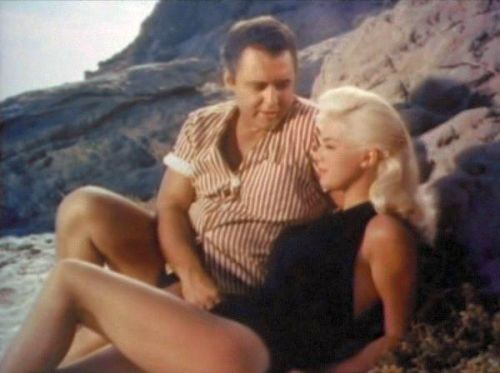
Miss Diana Dors: Singer, actress, and professional sexpot.

One of my favorites.

The photo shoot with this silver swimsuit must have lasted for days, considering how many pics are floating around.

There is something very Ed Woodian about this one.

Yes, I was late again! And for my last entry on Diana Dors week, too. Today’s allegedly good reason is because I am in a tizzy, as some newbie film blogger is stealing my shtick! They’re becoming quite popular, too, because I am a genius, and even pale imitations of me glow like a uranium suitcase in the hands of a modern day Pandora. (Impressed? Of course you are. Excuse me while I practice the Queen’s wave…)

Speaking of being popular, as Bryce recently pointed out to me, I have hit and passed the 200 mark for Google Followers. Thank you all. I do appreciate it and I love every one of you, even if I get into tizzies and can only express myself in hipster sarcasm. Have a good weekend everyone.

Diana Dors: The Unholy Wife (1957)


“The Unholy Wife” proves that Diana Dors could, in a pinch, act. It also proves she needed a strong director and a good story, both of which are sadly lacking in TUW.

The poster tagline — “HALF-ANGEL, HALF-DEVIL, she made him HALF-A-MAN!” — is pretty much a lie. You see nothing of Phyllis (Dors) to indicate she’s an angel at all. However, what makes her a “devil” is nothing more than her rejection of a checklist of stereotypical female traits. She doesn’t really like kids, she won’t care for her elderly nutball mother-in-law (Beulah Bondi), she doesn’t like being married to a man who apparently had his whatsit shot off in the war (Rod Steiger)… and it’s that issue with his whatsit that makes him “half a man”, not his wife Phyllis.

Oh, and she murders someone. This was all kinds of confusing, but allow me to try to explain: The film opens with Phyllis just randomly shooting a gun to scare her mother in law. She pretends there was an intruder in what I assume was part of a cunning plan. Mom-in-law Emma calls the cops. They arrive coincidentally along with Phyllis’ brother-in-law, a priest. The cops are satisfied with Phyllis’ story, priest goes home, Emma goes back to bed, then Phyllis’ boyfriend on the side shows up. They kiss and argue and kiss and he sneaks out, but Phyllis’ young son sees them.

Now, the part that confuses me is that some time passes before Phyllis’ plan goes into action, and I’m not sure if she was wickedly cunning or if she just shot the wrong guy. A businessman wants to buy her husband Paul’s vineyard, but he won’t sell. His neighbor and best friend Gino wants to sell his vineyard, and Paul gets into a huge fight with him about it.

But first, backstory! Paul and Gino were war buddies in the Big City for a conference or something when they met two slightly gold digging dames in a bar, Phyllis and Gwen. Paul hooked up with Phyllis, Gino with Gwen, and they eventually marry. Gino and Gwen are a nice couple, while Paul and Phyllis … wait, I just realized their names start with the same letter. Uuuuuugggghhhhh. That’s worse than color-coding the outfits of people in a movie so you “subconsciously” know that they’ll eventually end up together. All right, okay, fine, moving along: Paul and Phyllis don’t get along. He’s nice and sweet to her but she’s a dragon woman who doesn’t love his home and his family like she’s obligated to. Also, he likes her little son from a previous marriage/dalliance/something, but she just wants to be fabulous and has no time for kids.


Back in the present day, Gino and Paul make up after the fistfight. Gino heads to Paul’s house for a talk or a drink or something. When he comes in, Phyllis shoots him, I guess because she thought he was Paul. It’s hard to tell because her face registers no expression. Paul takes the blame for the murder, saying it was an accident.

Phyllis very helpfully gets confused on the stand to try to get Paul “accidentally” convicted. Meanwhile, she’s banging her boyfriend on the side in the wine cellar, which is underground and red and EVIL! OH HAY, DID I MENTION THIS WAS THE UNHOLY WIFE, BECAUSE THIS WINE CELLAR WHERE SHE’S MEETING WITH HER LOVER LOOKS A LOT LIKE HELL. IT’S KIND OF A METAPHOR OR SOMETHING.

Director John Farrow is about as subtle as a sledgehammer. Paul loves children, his mother, apple pie and baseball; his brother is a priest; he lost his wang in the war. HE’S HOLY, I TELLS YA! HOLY! I’m waving a small American flag right now!

I was so disappointed in this. Farrow directed “Where Danger Lives” and “The Big Clock,” so you know he knows what noir is supposed to be. He even directed one of my favorite Saint films, “The Saint Strikes Back.” Unfortunately, TUW was just sloppy and poorly thought out and trite. The print TCM showed was rotten, too, impossibly dark with something very suspicious going on with the blues and the reds.

Diana was pretty good for the most part, especially the courtroom scenes and the final scene with the mother-in-law in her sick bed. Solid character actors Marie Windsor and Joe de Santis were excellent. But Arthur Franz, the guy who played the priest? Don’t talk to me about Arthur Franz. And I’m a little miffed at Beulah, too, to be honest.

P.S. I’m exaggerating about Paul’s pole. He confesses toward the end of the film that the Army doctors said he might not be able to have kids again, which I’m sure means injury, not complete loss of, the unit in question.

Diana Dors: Deep End (1970)


Note: This post deals with disturbing themes and sexual content. The pics are safe for work, but the overall post may not be safe for work, for your brain, or for your spirit. You’ve been warned.

Jerzy Skolimowski’s “Deep End” is messed up. Oh I know that sounds weak, that I should be calling it “disturbing” or “dark,” but that gives the film an air of propriety that I don’t think even Jerzy Skolimowski intended.

I caught “Deep End” a few minutes into it the first time it was on TCM and watched for Diana Dors, who I had already missed — her part is early in the film. I had no idea of its history or cult status, mainly because I don’t focus much on films from roughly the late 1960s to the early 1980s. There are exceptions, of course, but the more mainstream films in that time span don’t do anything for me, they so often seem to be edgy for edginess’ sake and lack soul. When I saw “Deep End” the first time, without having seen the beginning, I was mostly convinced that this was another example of lackluster shock film making of the era, but I wanted to see the whole film to be sure. So I caught it again the second time it was on TCM, and I confess my first impression was more cynical than it should have been.

Now, I think Skolimowski fully intended his characters in “Deep End” to be so selfish and confused that they appeared soulless. The film, however, seems to be exploring what happens when an excitable teen boy is mistreated and lost in the swinging, sexually free London of the early 1970s. Seeing the beginning, you see the roots of what young Mike has had to go through.

However, there is this undercurrent of women being out of control, of needing to be put in their place, that pisses me the fuck off. The main male characters are teenage Mike, as well as the swimming instructor and Susan’s fiance. The swimming instructor is a cad who gropes his teen girl students. The fiance is bland. And that’s it, that’s the extent of their offensiveness. But Mike is the hero, and at the end of the film after he’s played a ton of passive aggressive mind games with Susan while helping her to find the lost diamond from her engagement ring, it escalates to where she uses sex to get the diamond back. When she tries to walk off after getting the diamond, Mike kills her. She floats dead in the pool, her blood forming slo-mo ribbons around them, as he has sex with her corpse. Our hero, ladies and gentlemen.

Keep in mind that Susan is portrayed as deserving this, because she’s been an “immature tart”, a jackass to Mike by saying mean things, she’s a cocktease, and she may even be a whore who dances nude! It’s true! So clearly she deserves to die.

And Diana Dors, sadly, is part of this anti-woman theme. She plays a 40-something woman, a little overweight, her platinum dye job going south, her cheap department-store clothes unflattering.

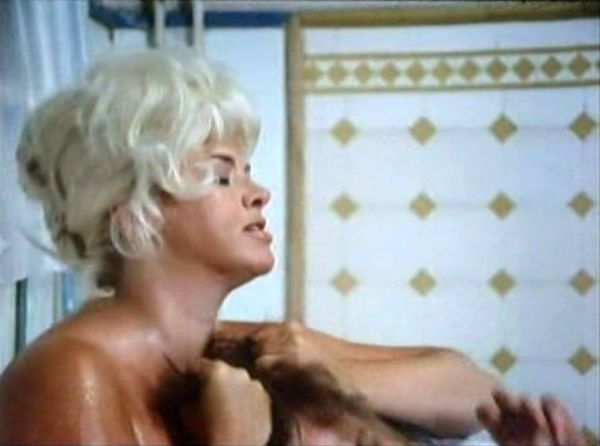
Mike works at a public bathhouse with Susan, and it is understood that they will each take some clients who come in for some kind of non-penetrative sexual release. Mike is 15 years old, I believe, or perhaps 16; he has quit school to go to work because his family needs the money. His first female client-in-quotation-marks is played by Diana Dors, and she, to put a fine point on it, sexually abuses him.

She gets off on shoving an unwilling Mike around, pulling his hair, and forcing his head against her breasts while she shouts some double entendre football talk. It’s probably supposed to be funny; however, it’s the beginning of the abuse Mike takes which ultimately leads him to murder.

“Deep End” tries to be both cult film and mainstream accessible, so it succeeds at neither. It’s got all the hallmark pseudo-indie quirks of dark comedy films of the era, up to and including Cat Stevens, and I can’t take it seriously. When there is an actual attempt at comedy, such as during the porn movie scene, the film is good. It’s very good. When the forced wackiness and choreographed zaniness starts, it falls apart.

I know everyone loves “Deep End”, more even than they love “Zabriskie Point”, which is why I’m turning off comments. Between the theme of this movie and my mostly-negative reaction, the last thing I need is to get into arguments online. I mean no offense by this, it is entirely a time management technique.

However, I would like to point you all to an excellent reflection on the film here at Britmovie by D.R. Shimon. It’s positive, it’s insightful, and it’s well worth the read.

Diana Dors: Swingin’ and Actin’

Yes, I’m a little late today, but again I have a very good reason: I spent the evening accidentally covered in ants. Little tiny ants. I had to get a little tiny gun so I could shoot off their antennae and save the world.

Today, allow me to treat you to some fine poster art featuring Diana Dors and, inevitably, two of her most famous assets.

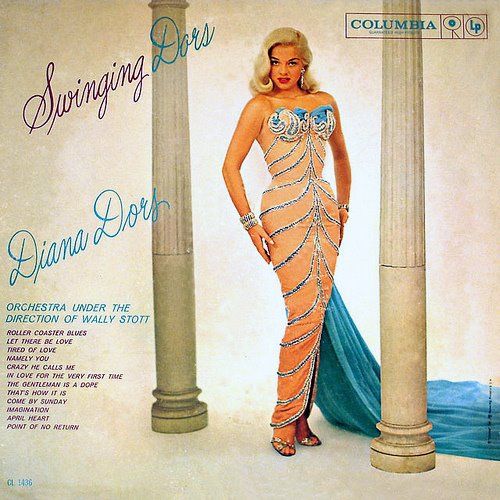
This is the only album she ever released, although she did sing in several films during her career. The “Swingin’ Dors” album name never gets old.

George Brent and Diana Dors. Why have I not seen this movie? Sometimes I just don’t understand myself.