Monthly Archives: November 2010

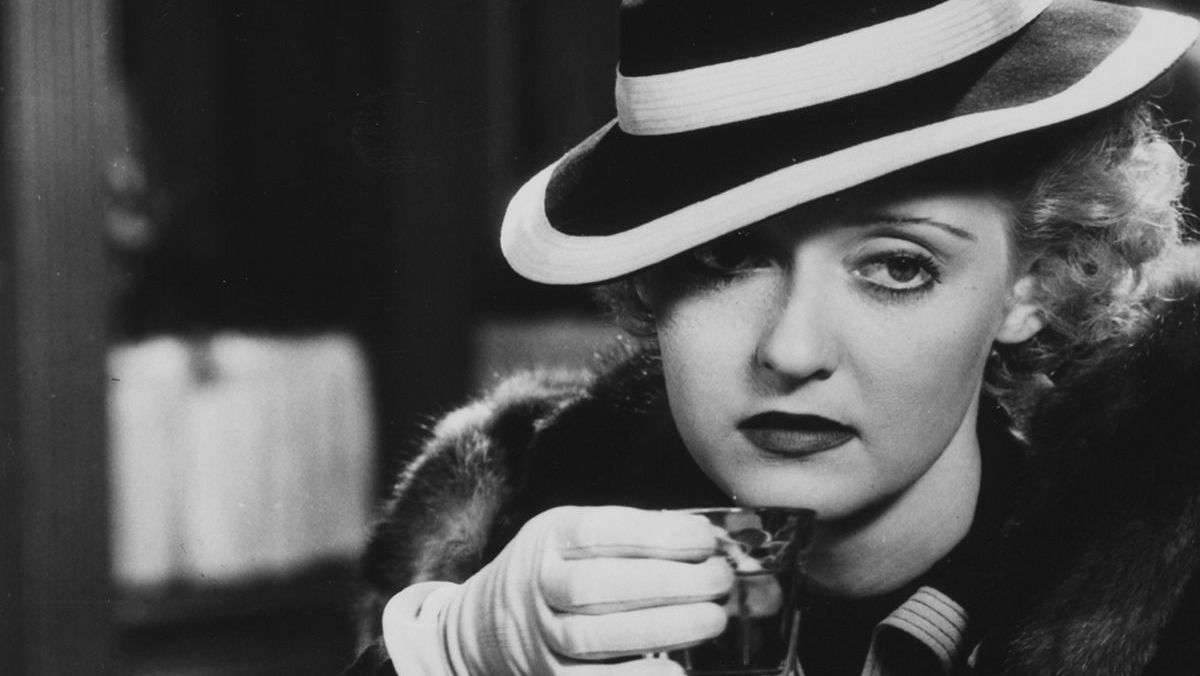
Bette Davis Project #13: That Certain Woman (1937)

“That Certain Woman” (1937) was the 3rd of a group of Bette movies I watched all in one night and was, by far, my favorite. Sadly, my copy of the film is poor, which you’ll confirm by looking at my screencaps. It’s available on DVD now but at a hefty price, so I won’t be getting a good copy of this any time soon. But if you get a chance to see this film, do! “That Certain Woman” is one of the few 1930s Bette melodramas that distinguishes itself from the others that so often feel like Kay Francis’ castoffs.

For some reason, the copy TCM has covers the edges of the title screen with a grey border so you can’t see the usual “First National Picture” credit on the bottom. No idea why. I assume it’s a re-release print with some copyright issue.

The plot of “That Certain Woman” is compelling in a way that your usual WB programmer isn’t. Bette is Mary Donnell, who we first see going to the cemetery on a cold, rainy evening in 1933. She’s followed there by a reporter who confronts her: She’s the former Mrs. Al Haines, widowed exactly 4 years earlier when her gangster husband was killed in the St. Valentine’s Day massacre. The reporter is doing a “where are they now” series on people involved in the massacre, but Mary won’t have anything to do with it. She’s got a job as a secretary now, a new life, and is as far away from the mob as she can be.

Unfortunately, the reporter knows about her new life and confronts her at her work. She’s afraid her boss Lloyd Rogers (Ian Hunter) will find out about her past, but it turns out he knew anyway. He’s smitten with Mary but, of course, Mary is smitten with someone else — a client’s son, Jack (Henry Fonda).

When Lloyd helps her out with the newspaper situation and with Jack as well, there is a moment where a positively radiant Mary runs up to Lloyd’s desk and thanks him.

It’s an expression of undiluted joy that lasts a brief instant and is gone as Mary runs out of the office to her love. The close-up on Mary’s face is tight but doesn’t linger, although the viewer is left with the image of Mary’s happiness long after she’s left the room. When a saddened Lloyd realizes that he and Mary were not meant to be, you genuinely feel his sense of loss.

Mary and Jack elope but Jack, being your standard soaper rich boy, is coerced away from her almost immediately by his overbearing father who knows Mary’s past. In a plot point used in something like five million weepies from 1925 through 1945 inclusive, Mary is pregnant when Jack leaves and doesn’t tell him, deciding she only wants him if he comes back on his own. He doesn’t. Instead, Mary raises her son on her own with financial help from Lloyd. Meanwhile, Jack marries some society dame. He soon causes a car wreck, seriously disabling his wife Flip (Anita Louise).

A few years pass; it’s now 1937. Lloyd, still in love with Mary, visits her while he’s seriously ill. He dies at her apartment while yet another snoopy reporter is hanging around, and Lloyd’s newly-widowed wife thinks Mary’s son was fathered by Lloyd. The press has a field day with the scandal. Even though Mary won’t reveal that Jack was really the father, Jack still discovers that he had a son and comes back to Mary, promising to divorce the now-disabled Flip and marry Mary for real this time.

Except Flip visits Mary herself and confesses she can’t be a real wife to Jack because of her injuries, she probably doesn’t have long to live, and of course she can’t have kids, so she wants Mary to take Jack so he can be happy. Mary, out of guilt and self-sacrifice and all those other things that make good melodrama, instead decides to give up her son and let Jack and Flip raise him.

At this point, the movie turns inadvertently cruel: Mary apparently goes around Europe looking fabulous and distraught, just waiting for Flip to die.

One day she gets a call from Jack that Flip’s finally dead, and she and Jack practically cheer at the news. You have to laugh, because that is some screwed up shit right there. Jack is the one responsible for the fact that Flip lived for years in pain before dying decades before her time, and he’s also responsible for Mary’s predicament in being a single mother. Why anyone thought it was appropriate for him to be calling Mary with the “good news” that his wife Flip was dead is beyond me, but I admit I enjoyed the ending immensely.

Also, Ian Hunter is terrific. I am loving the hell out of Ian Hunter right now. He is so good in these programmers because he actually works at his role, he never seems bored or like he’s holding back. I’m lookin’ at you, George Brent.  That said, I forget Ian is even in films like “Robin Hood” or “Ziegfield Girl,” so perhaps sometimes he doesn’t make much of an impression. Or maybe it’s just me.

certain1

Bette rocks a lot of looks in this film. When we first see her she’s dowdied up, looking for all the world like she did in the early 1930s when at Universal, except in fashions that were out of date even in 1933. I thought that was a terrific touch, not only giving the movie the feel of 1933, but also showing Mary as a girl who hadn’t moved on from what happened to her in 1929.

It’s also obvious that a lot of effort was spent to give Bette significant movie star appeal. Bette herself said that the first time she honestly looked like a star was when director Edmond Goulding worked with her in “That Certain Woman.” It seems odd for her to say such a thing, since in previous years she had been in “Petrified Forest” and “Of Human Bondage”, and even won an Oscar in “Dangerous,” but it’s true that WB was simply not treating her like one of their big name stars. I would argue, though, that the real change for Bette came with “Marked Woman” released a few months earlier, and which I believe was the first film she did after her suit against WB semi-failed.

It’s hard to see because of the poor video quality, but there is a little lovely art deco in Lloyd’s office in the beginning:

“That Certain Woman” is available on the WB Archives series if anyone has an extra $23.00 laying around. Silly sellers online are still charging $30.00 for their used VHS of the movie. The point is, it’s out there in legitimate copies, if you want to shell out significant dough for it.

certain2

Lobby card for the film. I don’t remember this scene at all.


Bette Davis Project #12: Front Page Woman (1935)

“Front Page Woman” was released a mere six weeks after “The Girl from 10th Avenue”, and it shows. These two programmers share 6 cast members and even some of the same sets. Long-time readers will remember how tired I have become of George Brent playing the guy trying to keep a woman in the home where she belongs. Well, folks, “Front Page Woman” is by far the worst offender in that category… thus far.

Ellen (Bette Davis) is a young reporter assigned to cover the execution of a murderer at midnight. Boyfriend and fellow reporter Curt (Brent) doesn’t think a woman should be reporting on such a thing and, true to 1935, Ellen faints to prove how right he was. I’m surprised she didn’t lose a heel while running or fend off the bad guy by hitting him with her purse. Maybe I should mention that Curt and the other reporters deliberately set out to upset her with graphic talk about the execution.

Curt writes two news stories, one for his paper and one for Ellen’s to cover for her womanly inability to report the news, but a screw-up causes the exact story to go into both papers. Ellen thinks he deliberately sabotaged her, and he might as well have: At a 3-alarm fire, Ellen is not allowed in to the area to report on the news because she’s a woman. Curt adds to this problem by lying to the police officers that she’s not even a reporter in the first place.

front1

But she sneaks into the area anyway and sees Marvin Stone (Huntley Gordon, who just happens to be in the featured photo for October in the AMS Silent Movie Calendar, which I’m looking at right now.) Ellen realizes Stone is important in the mystery of who started the fire, but he disappears, only to turn up dead at the hospital. Curt, angry that Ellen found all this out on her womanly own, what with being a dumb woman and all, wants her to quit her job and marry him instead. She agrees that if Curt solves the arson and murder before she does, she’ll quit and marry him. He responds by stealing her scoop on Marvin Stone.

I want to mention at this point that the movie (and I assume the Saturday Evening Post story it was based on) don’t feel it’s enough to disparage Ellen. They include the character of Nell, a large 40-something woman who is referred to only by her weight, veiled negative references to her assumed lesbianism, and how “ugly” she is:

front2]

Oh yeah, she’s so ugly, how can anyone bear to exist near such hideousness, etc. etc. Grace Hayle is gets no screen credit here, but she rarely did in any film, although the official off-screen credit for her roles were usually “Fat Lady” or “Chubby Woman”. Not just in the 1930s, but straight through to the 1950s. Also, her stereotypical lesbian garb in “Front Page Woman” was still in use nearly 30 years later for the dismissive ornithologist in “The Birds.” Hollywood ain’t exactly progressive.

Moving on: In the course of digging around to find out what happened, she gets held at gunpoint by Inez (Winifred Shaw) and Curt knows this, but refuses to help her in any way to “teach her once and for all that a woman’s place is in the home.” And I suppose if the desperate and obviously-involved-in-murder Inez shoots Ellen, that will really teach her.

front3

Curt then interferes with the trial of the person who allegedly murdered Stone, not just by eavesdropping on the jury, but by creating phony jury ballots and leaving them in the jury room so Ellen sees the wrong verdict. When she falls for the stunt and both papers get published before the verdict was even given — Ellen’s with the wrong verdict, Curt’s with the correct one — the judge gets a little pissed at Curt. Finally. Man, by this point in the film I was seething. Curt was portrayed as though he was the freakin’ police commissioner with everything he got away with up until that point, and the unethical way he stole others’ work and his interference in an important court case was so unbelievably wrong. But I had to laugh at New York Times reviewer Frank S. Nugent who wrote of this impossible scenario that “we have no doubt that any reporter showing his press card in the lobby of the Strand after a performance will be mobbed by hordes of autograph seekers.”

front4

Ellen gets the last laugh by getting a confession from the real murderer, and Curt pretends he thinks women really are as good as men, so she quits her job and they get married.

Unbe-freakin-lievable.

I could have forgiven a lot if this film hadn’t looked so much like “Girl from 10th Avenue,” which I had just watched, and which people in 1935 would have just seen a few weeks earlier. Here’s an example of the similarity:

front5Phone booths in “Girl from 10th Avenue.”


front6Phone booths in “Front Page Woman.”


I believe the apartment Bette and Ian Hunter share in “Girl From 10th Avenue” is the same set seen briefly inside the apartment building that burns down in “Front Page Woman,” too.

Also if the film hadn’t required me to suspend 100% of my disbelief, I would have been happier. Oh, I’ll suspend some disbelief. You gotta suspend if you want to watch movies, but this movie asked too much of me and I wasn’t willing to give it as much leeway as it needed to be entertaining.

The good news is I really, really liked the next Bette film that I’ll post about in the Project, so you get a reprieve from hearing me bitch about her early work. For a while, at least.

front7

"Female" and "Footlight Parade"


Back in April, I briefly blogged about “Female” (1933). Florence Craye (no relation) mentioned that the swimming pool at Alison’s ridiculously amazing home was the set used in “Footlight Parade.”

The “By a Waterfall” set in “Footlight Parade”:

A close-up of the set just in front of the fountain as it appeared in “Female”:

They added some wacky art deco statues of nekked mens and some plants to the fountain, but that’s the same pool all right. You can see it on this segment of “Female” on YouTube here, starting at 1:55.

Meanwhile, one of those wacky art deco men crashed a Corrine Griffith photo shoot:

Thank you once again, The Secret Life of Objects, for making movies even more fun than they already are.

Marie Prevost Project #2: "A Scoundrel’s Toll" (1916) and others


We just visited “Those Bitter Sweets,” allegedly Marie’s first film. Was it? Hell if I know.

This #2 post in the Project is the first of probably several posts where I can do nothing but list a bunch of Marie’s films that aren’t readily available or are lost, so take a seat and buckle yourselves in. It’s gonna be a long one.

I would like to note briefly that someone in 2008 copied the IMDb listing for Marie here, and you’ll see “The Locked Door” (1929) isn’t listed. As I mentioned before, when I started this project in 2008, that mistake was not on the IMDb. I’m sure someone saw the film on TCM when it showed in late 2008, thought Betty Bronson was Marie Prevost, and added her as “roomate” (sic) because Bronson’s character was indeed William “Stage” Boyd’s roommate and sister in the film. Now that it’s there, I can’t seem to get the IMDb to remove it.

This is something I’ve talked about before, and I’m repeating myself for a reason: This is the perfect example to illustrate why this project is so difficult. There is precious little about Marie available and what’s out there is often wrong. This is especially true about her death, thanks to Kenneth “No-Talent Plastic Face” Anger and Nick “What’s An Encyclopedia?” Lowe.

It was the public perception of Marie that caused my interest in her in the first place. What I discovered when I was knee-deep in research was that Marie was one of the most popular actresses of the time, appearing on magazine covers consistently throughout the 1920s at an increasing rate, culminating in an average of once a month from late 1924 to early 1928. Her every move was reported in the L.A. Times, she received tons of fan mail, gossip reported about her was almost uniformly positive, and she was praised as highly talented by some of the best actors and directors of the day. Soon, though, I found that Marie Prevost, despite her significant fame in the 1920s, would have been completely forgotten had it not been for her untimely death; because of this, accurate details about her were ridiculously hard to come by.  So I, of course, invented the job of retrieving as much info about Marie as possible, then decided I was the best person for said job.  This is a totally healthy way to approach any hobby, by the way.

Much of what we know about Marie’s early life and career was mangled deliberately by Mack Sennett in an effort to spice up the publicity. I suspect that Sennett kept records but didn’t bother to organize them… but Brent Walker did. His Mack Sennett’s Fun Factory has probably the most complete collection of Sennett material and records available, and it’s exactly what I need for this project; however, neither the local library nor the university library will get a copy of it (low demand, high price) so I’m kind of stuck for the moment. Trust me, owning a copy of that book is my immediate mission. Donations to the Get Stacia A Copy Of Brent’s Amazing Book Fund can be made via my Paypal link in the sidebar –>

I’m only partly joking about that.

Sources are also a problem. The last primary sources of information on Marie died in the 1960s.  Most secondary information online, especially that on the IMDb, was provided by volunteers, and as you can see from my notes below, even those who signed their names to the information are impossible to contact or no longer remember their sources. If any of these provided incorrect info as someone did with “The Locked Door,” then I’m out of luck.

It doesn’t help when online databases have wacky misspellings of Marie’s name, like the BFI, who here spelled Marie’s name as “Marrie Prebout.” Pfft.

As for the Marie Project, anything dating from before about 1921 is going to be hard to verify, although I promise if I get better information, I will come back to correct what I’ve previously written. My goal is to make the Marie Project a significant online source of information about her. It’s significant enough that other websites are already stealing what I’ve written! I’m so proud!


***

On to her films. Her next four films may or may not exist anymore.  If there is nothing written next to the title, that means I know absolutely nothing about it:

* “His Father’s Footsteps” (1915)

 
* “Better Late Than Never” (1916): The All Movie Guide detailed description makes me think it might exist; however, I can find no confirmation as of yet. I have tried contacting the author of that AMG summary with no luck, so I don’t know where she got all her information.

 
* “Unto Those Who Sin” (1916): Again, the AMG summary is very detailed, but this time, TCM also has a summary. It should be noted that Denny Jackson contributed a bio of Marie on the IMDb stating this was her first film, and I emailed him to ask for his sources. He sadly did not remember anything except that his sources were some books on early Hollywood actresses.  It appears Denny’s sources may have been wrong, as you will see below under “Secrets of a Beauty Parlor”. With the information found online, though, I think it’s possible that “Unto Those Who Sin” exists in some form and is Marie’s first film. “Those Bitter Sweets” probably isn’t.

Marie in a Bathing Beauty promotional photo circa 1917.


* “Sunshine” (1916): I know nothing about this except it’s not a Fox-Sunshine comedy, despite the title and some of the actors.

* “A Scoundrel’s Toll” (1916):  Marie’s sixth film, another Sennett short. The Library of Congress has a print which, according to their Motion Picture Conservation Council quarterly reports, that was sent to “quality control” in 2001.  I presume other prints exist, as back when I started compiling my Marie Prevost master list, I noted that this had been seen at a film festival in 2008.  The problem is that I wrote down that it was the “LaSalle” film festival, which apparently does not exist. Such are my impressive note taking skills. 

Since that time, I discovered “A Scoundrel’s Toll” has been released on a 2007 DVD set. Sadly, it appears on the “Kings of Comedy: Masters of the Silent Screen” DVD set, which is … odd. Yeah, “odd” is the least libelous way for me to put it. The shorts in the set are presented edited down to clips of only a few minutes’ length, and Madacy Home Video has added sub-par sound effects and narration. I guess they thought viewers needed a narrator to help us follow the complicated plots. Come on, Madacy Home Video, was this necessary? You couldn’t have released the shorts in full? “A Scoundrel’s Toll” is only available on DVD in this form, as far as I know, and this form has no sign of Marie.

The only still from “A Scoundrel’s Toll” I’ve ever seen is here at Bruce Calvert’s amazing silent film resource site.

The next three shorts of Marie’s were also Sennett films:

* Her Nature Dance (1917)


Image courtesy the Cleveland Public Library digital collection of lantern slides. Boy, that looks like one classy film.

The Grey River Argus in New Zealand has been archived online, and you can see movie listings for “Her Nature Dance” here and here. An ad also appears in the Ashburton Guardian here.

The Kansas State Historical Society has the censorship records from the state Board of Review online, and they are always a hoot.  Here you can see that they wanted to eliminate “CLOSEUPS ON ALL NATURE DANCING – ALL SOLO DANCES – MAN SWINGING WOMAN IN HIS ARMS” in the film. Eliminating all nature dancing in a short called “Her Nature Dance” would very likely make this the shortest short ever shown in Kansas.

Note that Eve Golden in Golden Images: 41 Essays on Silent Film Stars says that “Her Nature Dance” was Marie’s first film. Again, it seems that information on Marie’s early works is so difficult to come by that there is no real consensus on what her first film was.

 
* “Secrets of a Beauty Parlor” (1917):  This is listed as preserved and restored by The Film Foundation and currently resides at the American Film Institute.  It is the only Marie Prevost film listed at Film Foundation, by the way. 

Government Attic has the Library of Congress quarterly Motion Picture Conservation reports (warning: PDF) which show this short as having been shipped to a collection (I assume they mean AFI) in 2002.  It was shown at Slapsticon in July, 2005.   I have seen a whopping two (2!) people talk about seeing “Secrets” and they both thought it sucked, so it’s not likely to be in any compilation releases any time soon.  I do want to note that Denny Jackson’s aforementioned IMDb bio of Marie indicates that she didn’t work between “Secrets of a Beauty Parlor” and “Uncle Tom Without a Cabin” made two years later.  This is patently false, as Marie is verifiably in many films between “Secrets” and “Uncle Tom”, and by “verifiably” I mean I’ve either seen these films myself or have seen movie promo material that clearly has her in it.


* “Two Crooks” (1917):  Pfft.

In the next Project entry, we’ll finally get to see Marie!

***  
Contents of this article © Stacia Kissick Jones and She Blogged By Night 2008 – 2013. All rights reserved. Unauthorized duplication of this material without express and written permission from this blog’s author and/or owner is strictly prohibited. Links to the blog alone (without direct quotes) may be used at any time. Short quoted excerpts may be used provided that full and clear credit is given. Content may be used for research purposes, published papers, essays, books, etc. but must be accompanied by full, appropriate and specific credit. See blog sidebar for more complete details.

Marie Prevost Project #1: Those Bitter Sweets (1915)


Sharp-eyed readers will note that this is titled Marie Prevost Project #1 when we’ve already had Project #1.  Starting now, I will be going through Marie Prevost films for the Project in chronological order, including those films of hers that do not survive or that I do not have copies of, and as such I’m numbering the posts chronologically. Previous posts in the Project will eventually be renumbered to reflect the correct order. If you want a refresher on the Marie Prevost Project, start here.

We live in a great time, my friends. Too many silents are lost — most of them, actually — yet through the miracle of home video and cable television, we have access to thousands of the titles that still exist. It’s because of this that I was lucky enough to discover that both Marie’s first and last films still survive and, surprisingly, are readily available.

According to Charles Foster’s excellent Stardust and Shadows: Canadians in Early Hollywood, Marie moved with the family to Almeda, California, at age 6. At 14, she graduated from high school and went to work in a law firm. The story sister Peg told decades later was that Marie, a 17-year-old law secretary, delivered law papers to Mack Sennett Studios one afternoon and was coerced to be in a short as a background player.  She was told to sit in a chair in the background of a scene and the chair, without warning, collapsed from under her.  Peg recounts that she later saw this scene and “Marie just bubbled.” Marie became an official Bathing Beauty the next day.

I mention all this because “Those Bitter Sweets” (1915) is considered Marie’s first film, yet there is no collapsing chair or table. In fact, I’m not even sure I can find her in the film, and I’ve spent serious amounts of time trying to decipher which blurry lady in this short is Marie, if any.

There are plenty of promotional pictures of Marie early in her career (again, see here), and she was recognizable as Marie Prevost from the very beginning, so it should be very easy to see her in “Those Bitter Sweets.” But it’s not. The IMDb lists Mae Busch as female lead and four bit player females in the cast, yet there are six bit parts: Four Beauties and two girls at the drugstore soda fountain behind Mae and Al St. John. You can see the Beauties well in certain scenes, well enough to rule them all out as Marie, although I think many assume the lady in the middle in the screencap below is Marie:


I don’t think that’s her, but hey, I can’t figure out who any of them are.  Some guesses:  I thought the third lady was Phyllis Haver, but after seeing this photo of Virginia Fox from the 1940s here, I decided it might be Virginia.   Also, I found this photo (click to embiggen) and I would say at least two of the ladies there are Beauties in my screencap.   However, I ultimately have no idea who these women are. 

And hey, let me show you a picture I have of Marie from an old newspaper article from 1920:


That doesn’t look like Marie to me, but it does look like the lady in “Those Bitter Sweets”!  This is when I seriously considered chewing my own foot off in frustration.

Indeed.


If that Beauty in the screencap isn’t her, then the closest match for Marie would be the lady sitting behind Mae and Al to the far left:


She’s got Marie’s chin and, if you watch her behavior, she moves like Marie. That’s the best I can do. I can’t tell you what film Peg Prevost was talking about in that interview, but it wasn’t “Those Bitter Sweets” unless there is missing footage.

“Those Bitter Sweets” is pretty good, though, and if you dig on old timey comedy shorts, you’ll like this.  It’s coherent and funny enough I found myself laughing out loud several times.   The plot, in short, is about two men who are fighting over Mae Busch. Harry McCoy, the loser, tries to get even by poisoning a box of candy and giving it to Mae. Mae doesn’t eat the candy, instead giving it to a friend.  Harry immediately changes his mind about that whole murder thing and tells Mae the candy is poisoned. Realizing the lady with the candy has driven off to the beach with a group of friends, everyone within 50 feet panics in Sennett-approved fashion to stop them from eating EVIL CANDY OF DEATH. Slapstick happens along the way, Mae Busch is effortlessly charming, and the story is clear, coherent, and edited well. I’m new to Keystone shorts and Mack Sennett, but I’ve discovered that a bunch of these quickie shorts don’t make a damn bit of sense and are sloppily made, to boot. In TBS, there are only two instances where crew members accidentally moseyed into the shot, for example. It’s very impressive.

Release date: June 7, 1915

Survival Status: Exists, available on “Krazy Keystone Komedies” DVD released in 2007 by Substance Video.

You can see it online from a festival showing that was uploaded here on YouTube.

***  
Contents of this article © Stacia Kissick Jones and She Blogged By Night 2008 – 2013. All rights reserved. Unauthorized duplication of this material without express and written permission from this blog’s author and/or owner is strictly prohibited. Links to the blog alone (without direct quotes) may be used at any time. Short quoted excerpts may be used provided that full and clear credit is given. Content may be used for research purposes, published papers, essays, books, etc. but must be accompanied by full, appropriate and specific credit. See blog sidebar for more complete details.